vLLM

vLLM

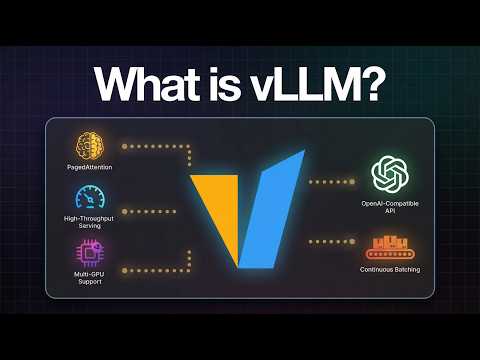
vLLM is a fast and memory-efficient inference and serving engine for Large Language Models (LLMs). It's designed for high-throughput serving with features like PagedAttention for efficient memory management, continuous batching for maximizing GPU utilization, and support for tensor and pipeline parallelism across multiple GPUs. It supports a wide range of transformer models and quantization methods. Targeted at developers, researchers, and engineers deploying LLMs in production or for experimentation. It provides an OpenAI-compatible API server out of the box, making it a drop-in replacement for existing inference APIs. Key technical features include prefix caching, quantization support (AWQ, GPTQ, etc.), and multi-GPU serving.

Coding
Visit website
Added on
Sep 22, 2026
LLM InferencePagedAttentionHigh ThroughputOpenAI APITensor ParallelMulti-GPU
Product information

Everything worth knowing about vLLM

The complete picture — from everyday features to the technical detail builders and IT folks dig for.

Core features

What it actually does

High-Throughput Inference
Serves LLMs with optimized memory management via PagedAttention, enabling high-throughput serving by batching requests and efficiently managing key-value cache memory.
Broad Model Support
Supports a wide range of transformer-based models, including popular architectures like LLaMA, Mistral, GPT-NeoX, and Falcon, as well as multi-modal models.
Continuous Batching
Dynamically groups incoming requests into batches to maximize GPU utilization and reduce latency, a core technique for efficient LLM serving.
OpenAI-Compatible API
Provides a drop-in replacement for OpenAI's API server, allowing easy integration with existing applications and tools built for the OpenAI API.
Technical capabilities
Tensor Parallelism & Quantization
Supports tensor parallelism for distributing models across multiple GPUs and various quantization formats (GPTQ, AWQ, GGUF) to reduce memory footprint and increase speed.
PagedAttention Kernel
Implements a custom CUDA kernel for PagedAttention, the core algorithm that enables efficient memory management for the KV cache, preventing memory fragmentation and waste.
Must watch videos
How to Self-Host an LLM: Local AI Inference with vLLM
11:06
Tutorial11:06
How to Self-Host an LLM: Local AI Inference with vLLM
Want to try for yourself? Find the code here → https://ibm.biz/~pDRvDsIfj Want to run an LLM on your own hardware? Cedric Clyburn demonstrates self-hosted AI inference with vLLM, from loading an open-weight model to serving it through an API. Learn how quantization, GPU memory, and model serving shape practical local AI deployments. 00:00 - Why Self-Host an LLM? 00:21 - What Is vLLM and Why It Matters 00:57 - Continuous Batching & Paged Attention Explained 02:16 - Two Ways to Use vLLM: Python vs API Server 02:45 - Choosing Open Models for AI Inference 03:23 - Running Offline Inference with Python 05:21 - Serving LLMs Through an API Endpoint 07:45 - Understanding Quantization and GPU Memory 08:37 - Using Compressed Models Efficiently 10:08 - Deploying and Evaluating AI Models with vLLM Explore more technical tutorials, articles, and learning resources here → https://ibm.biz/~KvxBUv6yY AI was used in the creation of the transcript and metadata for this video. #vllm #selfhostedai #opensource #opensourceai ----------------------------------------------------------------------------------------------------------- Find us on YouTube: 🔵 IBM Developer: https://youtube.com/@ibmdeveloperadvocates 🔵 IBM Technology: https://www.youtube.com/@IBMTechnology 🔵 IBM: https://www.youtube.com/@IBM Follow our Developer social channels: 🟣https://www.linkedin.com/showcase/ibmdeveloper 🟣 https://x.com/ibmdeveloper
What is vLLM? Efficient AI Inference for Large Language Models
4:57
Tutorial4:57
What is vLLM? Efficient AI Inference for Large Language Models
Ready to become a certified watsonx AI Assistant Engineer? Register now and use code IBMTechYT20 for 20% off of your exam → https://ibm.biz/BdnaVD Learn more about Large Language Models (LLMs) here → https://ibm.biz/BdnaVR 💰 Struggling with a slow and expensive AI infrastructure? Cedric Clyburn explains how VLLM tackles memory fragmentation and latency in serving large language models. Learn how innovations like paged attention optimize GPU resources and accelerate inference for scalable AI solutions! 🚀 AI news moves fast. Sign up for a monthly newsletter for AI updates from IBM → https://ibm.biz/BdnaVF #ai #llm #gpu #aidevelopment
Understanding vLLM with a Hands On Demo
15:17
Review15:17
Understanding vLLM with a Hands On Demo
🧪 vLLMs Labs for FREE — https://kode.wiki/4toLSl7 Most people can use an LLM. Very few know how to serve one at scale. This video breaks down vLLM, the inference engine transforming production AI deployments, and shows you exactly why it dominates when it comes to throughput, concurrency, and KV cache efficiency. No fluff. No theory overload. Just clear, hands-on learning starting from why your LLM is slow, all the way to launching a production-ready API server with a live monitoring dashboard. ───────────────────────────────────────── 📌 WHAT YOU'LL LEARN IN THIS VIDEO ───────────────────────────────────────── ✅ What LLM inference is and why tokens per second varies across platforms like ChatGPT & Gemini ✅ Comparison of different inference engines ✅ The KV Cache problem ✅ How PagedAttention works — inspired by OS virtual memory paging ✅ Demo - Build a monitoring dashboard to track throughput, latency & concurrency live 🧪 FREE HANDS-ON LABS INCLUDED — https://kode.wiki/4toLSl7 Practice everything in a real sandbox environment with no local setup, no credit card, no surprises. GPU environment, model weights, and all dependencies are already configured and ready to go. ⏱️ TIMESTAMPS 00:00 – Overview of LLM Inference Engines 00:52 – What Makes vLLM Stand Out 01:48 – How PagedAttention Works 02:31 – Other Inference Engine 03:44 – Lab Intro & Environment Setup 05:21 – Task 1 - Naive HuggingFace Inference 05:58 – Task 2 - vLLM Offline Interference 07:04 – Task 3 - The K Cache problem 07:52 – Task 4 - PageAttention 09:11 – Task 5 - Launch vLLM as an OpenAI-compatible API server 10:08 – Task 6 - Multi-user Throughput under load 11:29 – Task 7 - Tuning vLLM Parameters for Production 12:21 – Task 8 - Capstone (Building a Monitoring Dashboard) 13:54 – Key Takeaways & When to Use vLLM vs Other Engines #vLLM #LLMInference #PagedAttention #KVCache #LLMDeployment #LLMServing #AIEngineering #MLOps #LLMPerformance #HuggingFace #GPUOptimization #LLMTuning #GenAI #AIInfrastructure #LargeLanguageModels #DeepLearning #AIProduction #KodeKloud #LLMOps #MachineLearning #DevOps #CloudAI #AIDevelopment #OpenAI

Who uses it

Real use cases, no hype
High-Throughput LLM Serving
Deploy and serve large language models at scale with maximum throughput for production APIs.
Real-Time Chat Applications
Power interactive chatbots with low-latency, OpenAI-compatible endpoints.
Batch Inference Pipelines
Process large datasets of text generation tasks efficiently via batched requests.
Multi-Modal AI Deployment
Serve vision-language models (e.g., LLaVA) for integrated image and text understanding.
Cost-Effective Model Serving
Utilize quantization and memory optimization to run large models on consumer or prosumer GPUs.
What's great
  • State-of-the-art throughput for serving large models
  • Seamless OpenAI API compatibility
  • Multi-GPU & tensor parallelism out-of-the-box
  • Handles multi-modal models (vision-language)
Technical strengths
  • Blazing fast LLM inference with PagedAttention
  • Supports latest quantization (AWQ, GPTQ, FP8) & speculative decoding
  • Highly optimized CUDA kernels for attention & GEMM
Where it falls short
  • Steep GPU memory & VRAM requirements
  • Complex initial setup for custom model architectures
  • Community support can be slow for niche edge cases
  • Documentation sometimes lags behind rapid release cycles
Technical limitations
  • Hardware-specific optimizations can be fragile across CUDA versions
  • Debugging kernel-level issues requires deep CUDA expertise
For technical folks

The deep-dive specs

FAQ

Includes technical Q&A
vLLM introduced PagedAttention, a technique that manages key-value (KV) cache memory similarly to an operating system's virtual memory. This eliminates memory fragmentation and waste, enabling massive throughput gains and support for very long sequences.

Traffic Insights

Monthly Visits

—

October 2026

Growth Rate

0%

vs last month

Dominance

0%

in Coding

Top Country

—

Top Countries Breakdown

—

Growth Trend

Stable

Traffic has remained stable.

Pricing overview
Unknown Pricing

vLLM Pricing

vLLM uses a unknown pricing structure. Real-time rates, custom enterprise quotas, and plan details are managed directly on their official platform.

Check Pricing on vLLM
Reviews

What the internet actually thinks

Data refreshed weekly. No paid placements.

Trustpilot
Not reviewed yet
G2
G2
Not reviewed yet
C
Capterra
Not reviewed yet
Product Hunt
Not reviewed yet
COMMUNITY COMMENTS

Leave a Comment

Help others make informed decisions. Your honest feedback shapes the community's understanding of this tool.

Tips for commenting

  • •Be specific about features you used
  • •Share real use cases and results
  • •Mention both pros and cons
  • •Keep it honest and constructive
to leave a comment

Your comment is published immediately.

Filter:
Sort:

No comments yet

Be the first to share your experience with this tool.

Alternatives

Not quite the right fit?

Here's what else is out there.