SGLang

SGLang

SGLang is an open-source inference framework designed for production-level serving of large language models (LLMs) and multimodal models. It delivers low-latency, high-throughput inference across single GPUs to large distributed clusters, supporting a wide range of hardware including NVIDIA, AMD, Intel, Google TPU, and more. Key capabilities include RadixAttention for efficient prefix caching, multi-GPU parallelism, and broad compatibility with models like Llama, Qwen, and DeepSeek via Hugging Face and OpenAI APIs. The framework is optimized for real-world deployments, powering over 400,000 GPUs globally and generating trillions of tokens daily. It features native support for advanced model architectures like Mixture-of-Experts (MoE) and includes specialized engines for diffusion models. Installation is straightforward via pip, Docker, or Kubernetes, with cloud deployment options for AWS SageMaker and other platforms. Targeted at AI researchers, ML engineers, and platform developers

Coding
Visit website
Added on
Sep 22, 2026
LLM Serving FrameworkOpenAI-Compatible APIMulti-GPU SupportNVIDIA + AMD GPUsRadixAttentionPrefix CachingKubernetes DeployDocker SupportProduction Grade
Product information

Everything worth knowing about SGLang

The complete picture — from everyday features to the technical detail builders and IT folks dig for.

Core features

What it actually does

High-Performance Inference Serving
Delivers low-latency, high-throughput inference for large language and multimodal models in production environments.
Broad Model & Hardware Support
Natively supports models like Llama, Qwen, DeepSeek, and GLM. Works across NVIDIA, AMD, Intel, Google TPU, and Ascend hardware.
OpenAI-Compatible API
Provides a familiar API interface, allowing easy integration and migration from existing OpenAI API-based applications.
Extensive Deployment Options
Install via pip, Docker, Kubernetes, SkyPilot, or AWS SageMaker for flexible deployment from single GPUs to large clusters.
Technical capabilities
RadixAttention & Prefix Caching
Implements RadixAttention and prefix caching to optimize attention computations and reduce redundant processing.
Multi-GPU Parallelism & Disaggregation
Supports tensor and pipeline parallelism across GPUs, along with PD disaggregation for scaling large models.
FlashInfer Attention Backend
Uses the FlashInfer library as its default attention kernel backend for optimized GPU performance on supported hardware.
Must watch videos
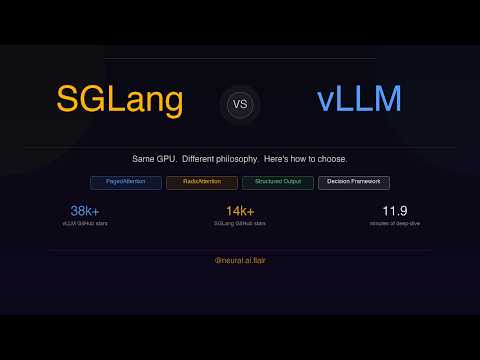
SGLang vs vLLM: Which LLM Inference Framework Should You Use?
11:51
Comparison11:51
SGLang vs vLLM: Which LLM Inference Framework Should You Use?
Two frameworks dominate production LLM serving today — SGLang and vLLM. Same GPU. Same models. Wildly different results depending on your workload. In this video, we break down: The KV cache bottleneck both frameworks solve vLLM's PagedAttention — virtual memory for the GPU SGLang's RadixAttention — shared prefix caching as a radix tree Structured output: logit masking vs compiled FSM Throughput benchmarks across diverse and prefix-heavy workloads Latency: TTFT, TBT, and P99 tail latency comparison Multi-GPU scaling and production maturity Ecosystem and integrations The exact decision framework for choosing between them The one question that decides everything: what percentage of your tokens are shared across requests? Above 40% → SGLang. Below 40% → vLLM. 🔔 Follow @neural.ai.flair for more AI systems explainers.
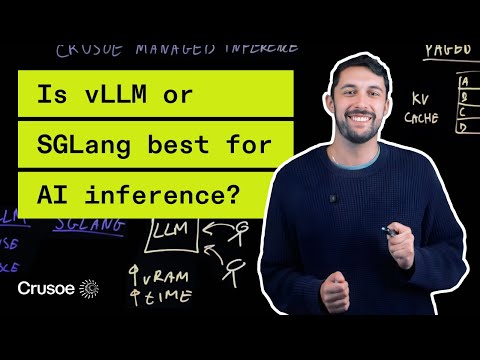
AI Lab: Open-source inference with vLLM + SGLang | Optimizing KV cache with Crusoe Managed Inference
3:47
Tutorial3:47
AI Lab: Open-source inference with vLLM + SGLang | Optimizing KV cache with Crusoe Managed Inference
The AI revolution demands a new kind of infrastructure — and the AI Lab video series is your technical deep dive, discussing key engineering challenges and providing the blueprint you need to build the future of AI. For those who have struggled with crippling inference latency when serving a large language model, this video provides the technical guide for understanding how to begin optimizing. Crusoe Solutions Engineer Martin Cala dives deep into the architecture of high-throughput open-source LLM inference, explaining the core problem and how key innovations deliver massive performance gains. The challenge is clear: traditional methods waste huge amounts of GPU vRAM through memory fragmentation. The solution lies in a clever trick borrowed from operating systems: Paged Attention. In this episode, we cover: Paged attention: The core optimization that breaks the KV cache into uniform, fixed-size memory blocks to eliminate fragmentation and dramatically improve GPU utilization. vLLM + SGLang: A technical breakdown of the two leading open-source inference engines built on this principle, detailing when to use vLLM (high-throughput for dense models) and when SGLang excels (complex MoE architectures, function calling, and JSON parsing). The operational burden: Why managing these advanced, complex optimizations on purpose-built infrastructure is a major barrier for most companies. Chapters: 0:18 – The core problem: KV cache memory fragmentation 1:00 – Paged Attention: A game-changing OS trick 2:05 – vLLM: The high-throughput default for dense models 2:25 – SGLang: When to choose MoE and complex application runtimes 2:59 – Eliminating operational complexity with Crusoe Managed Inference For most companies, managing the complexity of paged attention, a cluster-wide KV cache, and resilient scaling is a huge operational burden. That's why we built Crusoe Managed Inference. We handle the infrastructure, the proprietary memory fabric, and the advanced cluster optimization, freeing your engineers to focus solely on building your product. Ready to stop optimizing infrastructure and start innovating? Crusoe Managed Inference: Learn how to access a cluster-wide KV cache and SLA-backed production deployments: https://www.crusoe.ai/cloud/managed-inference For AI engineers: Read the technical details of our proprietary platform: https://www.crusoe.ai/resources/blog/crusoe-memoryalloy-reinventing-kv-caching-for-cluster-scale-inference Launch blog: Get the full story on why we built Managed Inference: https://www.crusoe.ai/resources/blog/crusoe-managed-inference-optimize-performance-for-demanding-ai-workloads Start building today: Sign up for Crusoe Cloud and deploy your first workload: https://console.crusoecloud.com/request-foundry Don't forget to like this video and subscribe to the Crusoe channel for more episodes of AI Lab!
Introduction to LLM serving with SGLang - Philip Kiely and Yineng Zhang, Baseten
43:42
Tutorial43:42
Introduction to LLM serving with SGLang - Philip Kiely and Yineng Zhang, Baseten
Do you want to learn how to serve models like DeepSeek and Qwen with SOTA speeds on launch day? SGLang is an open-source fast serving framework for LLMs and VLMs that generates trillions of tokens per day at companies like xAI, AMD, and Meituan. This workshop guides AI engineers who are familiar with serving models using frameworks like vLLM, Ollama, and TensorRT-LLM through deploying and optimizing their first model with SGLang, as well as providing guidance on when SGLang is the appropriate tool for LLM workloads. About Philip Kiely Philip Kiely leads Developer Relations at Baseten. Prior to joining Baseten in 2022, he worked across software engineering and technical writing for a variety of startups. Outside of work, you'll find Philip practicing martial arts, reading a new book, or cheering for his adopted bay area sports teams. About Yineng Zhang Yineng Zhang is a Software Engineer at Baseten Model Performance team. He is also a core developer of the SGLang project. Recorded at the AI Engineer World's Fair in San Francisco. Stay up to date on our upcoming events and content by joining our newsletter here: https://www.ai.engineer/newsletter 00:00 Introduction to LLM serving with SGLang 02:14 What is SGLang? 03:36 History of SGLang 06:49 Deploying Your First Model 13:01 Optimizing Performance with CUDA Graph Max Batch Size 24:19 Optimizing Performance with Eagle 3 Speculative Decoding 30:02 SGLang Community and Contributions 35:24 Invitations and Job Opportunities 36:52 Q&A

Who uses it

Real use cases, no hype
High-Throughput API Serving
Deploy LLMs as production APIs with low latency using RadixAttention and prefix caching.
Large Model Distributed Inference
Serve models requiring multi-GPU or multi-node setups, like DeepSeek-R1 or Kimi-K3.
Cost-Effective Multimodal Deployment
Run vision and video models (e.g., GLM-5.3-Flash, MiniMax-H3) on consumer or cloud GPUs.
Research & Prototyping
Quickly test new model architectures and optimizations with OpenAI-compatible endpoints.
Cloud-Native Scaling
Deploy on Kubernetes, Docker, or clouds (AWS, GCP) with operators like OME or SkyPilot.
Production RL Workflows
Integrate with major RL frameworks for training and fine-tuning pipelines at scale.
What's great
  • Blazing fast inference with RadixAttention and prefix caching.
  • Broad hardware support: NVIDIA, AMD, Google TPU, Ascend NPU.
  • Extensive model ecosystem: Llama, Qwen, DeepSeek, etc.
  • OpenAI-compatible API for easy integration.
Technical strengths
  • Multi-GPU parallelism for large models and clusters.
  • Day-0 support for cutting-edge architectures like DeepSeek-V4.1 Flash and Kimi-K3.
  • Deep optimization for specific backends (e.g., dsv4, KDA decode kernels).
Where it falls short
  • Complex installation with multiple methods and hardware-specific notes.
  • Requires CUDA 13; older CUDA 12 setups are retired.
  • Docker images are mutable, requiring careful version pinning for production.
Technical limitations
  • FlashInfer backend issues on older GPUs require manual kernel switching.
  • Nightly builds can be unstable; require specific pip flags to install.
  • Multi-node and cloud deployments add significant orchestration complexity.
For technical folks

The deep-dive specs

FAQ

Includes technical Q&A
Use pip: `pip install --upgrade pip && pip install uv && uv pip install --prerelease=allow sglang`. For the fastest setup, use Docker: `docker run --gpus all -p 30000:30000 lmsysorg/sglang:latest python3 -m sglang.launch_server --model-path meta-llama/Llama-3.1-8B-Instruct --host 0.0.0.0 --port 30000`.

Traffic Insights

Monthly Visits

—

October 2026

Growth Rate

0%

vs last month

Dominance

0%

in Coding

Top Country

—

Top Countries Breakdown

—

Growth Trend

Stable

Traffic has remained stable.

Pricing overview
Unknown Pricing

SGLang Pricing

SGLang uses a unknown pricing structure. Real-time rates, custom enterprise quotas, and plan details are managed directly on their official platform.

Check Pricing on SGLang
Reviews

What the internet actually thinks

Data refreshed weekly. No paid placements.

Trustpilot
Not reviewed yet
G2
G2
Not reviewed yet
C
Capterra
Not reviewed yet
Product Hunt
Not reviewed yet
COMMUNITY COMMENTS

Leave a Comment

Help others make informed decisions. Your honest feedback shapes the community's understanding of this tool.

Tips for commenting

  • •Be specific about features you used
  • •Share real use cases and results
  • •Mention both pros and cons
  • •Keep it honest and constructive
to leave a comment

Your comment is published immediately.

Filter by rating:
Sort by:

No comments yet

Be the first to share your experience with this tool.

Alternatives

Not quite the right fit?

Here's what else is out there.