Weaviate

Weaviate

Weaviate is an open-source vector database that stores and indexes both data objects and vector embeddings, enabling semantic and hybrid search, retrieval augmented generation (RAG), and agent-driven workflows. It provides built-in embeddings, a query agent for natural language queries, and persistent memory (Engram) for personalized AI experiences. Targeted at developers and AI teams, Weaviate offers deployment flexibility across cloud (Weaviate Cloud), Docker, Kubernetes, or embedded. It includes enterprise features like multi-tenancy, RBAC, SOC 2, HIPAA compliance, and billion-scale architecture. The platform is designed to accelerate AI application development from prototype to production, removing infrastructure overhead with auto-scaling, integrations with major model providers, and a rich set of SDKs and APIs.

Search
Visit website
Added on
Jul 13, 2026
Monthly Visits
8.1K
Vector searchRAGHybrid searchMulti-modalQuery AgentEngram memoryOpen source
Product information

Everything worth knowing about Weaviate

The complete picture — from everyday features to the technical detail builders and IT folks dig for.

Core features

What it actually does

Vector Search & RAG
Store and index high-dimensional vectors for semantic search, retrieval-augmented generation, and agentic AI workloads.
Query Agent (Natural Language)
Turn natural-language questions into precise Weaviate database operations without writing complex queries.
Built-in Embeddings Service
Access GPU-powered embedding models directly within Weaviate Cloud, eliminating the need for external pipelines.
Engram Persistent Memory
Provide LLM agents and applications with long-term, continuously learning memory for personalized user experiences.
Hybrid Search
Combine vector search with keyword-based BM25 scoring for highly accurate and context-aware retrieval.
Technical capabilities
HFresh & HNSW Indexes
Disk-optimized (HFresh) and in-memory (HNSW) vector indexes with advanced compression techniques for efficient billion-scale retrieval.
Multi-Tenancy & Async Replication
Native multi-tenancy supporting thousands of tenants in a single cluster with enhanced cluster-wide asynchronous replication.
Must watch videos
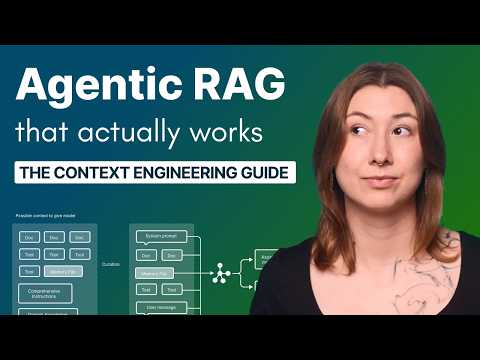
THIS is how you build agentic RAG systems that work
11:22
Tutorial11:22
THIS is how you build agentic RAG systems that work
Your RAG pipeline isn't failing because of bad prompts. It's failing because of bad context. In this video, Victoria breaks down the five systems that make up every agentic RAG pipeline that actually works in production. 1️⃣ Query Augmentation — translating messy human input into something your pipeline can actually use 2️⃣ Retrieval — chunking strategy alone can make or break your RAG performance 3️⃣ Memory — short-term vs long-term, and why just dumping history into context is a failure mode 4️⃣ Tools — most tool failures are context engineering failures in disguise 5️⃣ Agents — the orchestration layer that ties it all together (and compounds every failure when context breaks down) Resources: Ebook: https://weaviate.io/ebooks/the-context-engineering-guide?utm_source=youtube&utm_campaign=context-engineering Chunking demo: https://chunking.playground.weaviate.io?utm_source=youtube&utm_campaign=context-engineering Engram: https://weaviate.io/product/engram?utm_source=youtube&utm_campaign=context-engineering 00:00 - Intro 00:46 - Longer contexts are not better 01:18 - The context engineering system 01:36 - Query Augmentation 02:25 - Query Agents 03:25 - Retrieval & Chunking 05:42 - Memory 08:02 - Tools 10:08 - Agents 10:51 - Conclusion ▬▬▬▬▬▬▬▬▬▬▬▬ CONNECT WITH US ▬▬▬▬▬▬▬▬▬▬▬▬ - Visit http://weaviate.io/ - Star us on GitHub https://github.com/weaviate/weaviate - Stay updated and subscribe to our newsletter: https://newsletter.weaviate.io/ - Try out Weaviate Cloud for free here: https://console.weaviate.cloud/ Got a question? - Forum: https://forum.weaviate.io/ Connect with us on - Twitter: https://twitter.com/weaviate_io - LinkedIn: https://www.linkedin.com/company/weaviate-io/
Knowledge Engineering with Bradley Allen - Weaviate Podcast #139!
1:01:14
Tutorial1:01:14
Knowledge Engineering with Bradley Allen - Weaviate Podcast #139!
Dr. Bradley Allen brings five decades of AI history into a deep conversation on knowledge engineering, neurosymbolic AI, and the future of enterprise intelligence. The discussion begins with the boom-and-bust cycle of rule-based expert systems, AI winters, and why today’s large language model wave may be different. The conversation then turns to how knowledge is organized in practice, from personal piles of papers searched on demand to formal knowledge graphs built with classes, relations, ontologies, A boxes, T boxes, description logic, and subsumption-based reasoning. Allen explains why semantic web and biomedical ontology successes still leave unresolved questions about cost, maintenance, and whether LLMs can dynamically structure information in ways that preserve meaning. That leads into natural language concept definitions, LLM-based classifiers, rationales, probabilistic reasoning, and the challenge of updating classes as new edge cases emerge. From there, the focus widens to vector databases, semantic search, RAG, topic modeling, distributional semantics, and the ongoing revision required for systems that can never be “once and done.” Allen connects modern LLM behavior to the long history of formal languages, from Frege, Russell, Wittgenstein, Turing, and Gödel to theorem proving, soundness, completeness, paraconsistency, paracompleteness, and the pragmatic tradition of meaning through use. The closing stretch explores world models, reinforcement learning, tool-using agents, enterprise knowledge workflows, role-based access control, governance, normativity, and alignment, ending on the need to build accountable AI systems that channel powerful technology toward responsible outcomes. Links: Neurosymbolic Knowledge Engineering with Natural Language, a Ph.D. Dissertation by Bradley P. Allen: https://philpapers.org/archive/ALLNKE.pdf Chapters 0:00 Welcome Dr. Allen! 0:45 A Postmortem of Expert Systems 4:46 AI Winters 8:54 Personal Knowledge Engineering 14:14 Knowledge Graphs 23:32 Distributional Semantics 37:36 Formal Languages and Theorem Proving 51:51 World Models 58:51 Exciting Directions for AI
Can we win Europe's biggest Hackathon?
11:54
Tutorial11:54
Can we win Europe's biggest Hackathon?
▬▬▬▬▬▬▬▬▬▬▬▬ CONNECT WITH US ▬▬▬▬▬▬▬▬▬▬▬▬ - Visit http://weaviate.io/ - Star us on GitHub https://github.com/weaviate/weaviate - Stay updated and subscribe to our newsletter: https://newsletter.weaviate.io/ - Try out Weaviate Cloud for free here: https://console.weaviate.cloud/ Got a question? - Forum: https://forum.weaviate.io/ Connect with us on - Twitter: https://twitter.com/weaviate_io - LinkedIn: https://www.linkedin.com/company/weaviate-io/

Who uses it

Real use cases, no hype
Semantic Search
Index vectors for meaning-based retrieval across large document corpora
Retrieval Augmented Generation
Ground LLM outputs with relevant, up-to-date context from proprietary data
Recommendation Systems
Find similar items by vector proximity for personalized user experiences
Agent Memory
Persistent storage for AI agent state and long-term conversational history
Image Similarity Search
Use multi-modal vectors to find visually similar images at scale
Knowledge Graph Management
Combine vector search with cross-references for rich entity discovery
Enterprise Document Retrieval
Secure, tenant-isolated search across internal knowledge bases
What's great
  • Hybrid search combining vector and keyword
  • Open source with permissive BSD license
  • Multi-tenancy out of the box
  • GraphQL and REST APIs for easy integration
Technical strengths
  • HNSW index with quantization for memory efficiency
  • Modular design supports pluggable backends
Where it falls short
  • Self-hosted deployment requires DevOps expertise
  • GraphQL schema learning curve for beginners
  • Limited built-in integrations compared to competitors
Technical limitations
  • HNSW memory tuning can be complex for large datasets
  • Full-text ranking less accurate than dedicated search engines
For technical folks

The deep-dive specs

Architecture
Open-source AI-native vector database
Index Algorithms
HNSW, HFresh (disk-based), vector compression
Query Interface
GraphQL, REST, gRPC, Natural Language
Deployment Options
Cloud (WCD), Docker, Kubernetes, Embedded
Embedding Models
Snowflake Arctic, ModernBERT, OpenAI, etc.
SDKs
Python, TypeScript, Go, Java, .NET
Security Compliance
SOC 2 Type II, HIPAA, RBAC, SSO

FAQ

Includes technical Q&A
Weaviate is an open-source vector database for semantic search, RAG, and AI agent memory.

Traffic Insights

Monthly Visits

8.1K

September 2026

Growth Rate

-6%

vs last month

Dominance

0%

in Search

Top Country

Top Countries Breakdown

Growth Trend

Declining

Traffic has decreased compared to last month.

Honest pricing

No sneaky tiers, no “contact sales”

Here's who each plan is actually for — and where the hidden charges might hit.

Free
Free

Individuals

  • Always free — 1 cluster per user
  • upgrade to paid anytime
  • 100000 objects · 1 GB memory · 10 GB disk
  • 1 collection
  • up to 3 tenants
  • Embeddings (2
Flex
Most picked
$45/mo

Teams

  • Pay-as-you-go
  • monthly
  • no commitment
  • Shared cloud cluster with full core DB toolkit + replication
  • Baseline security with RBAC
  • Highly available clusters — 99.5% uptime
  • Query Agent free tier + usage-based; Embeddings usage-based
Premium
$400/mo

Enterprise

  • Prepaid contract with predictable spend
  • Choice of shared or dedicated deployment
  • Trusted reliability — up to 99.95% uptime
  • Global coverage on AWS
  • GCP & Azure
  • Query Agent free tier + usage-based; Embeddings usage-based
  • Enterprise support — as fast as 1-hour Sev 1 + dedicated Technical Account Team
Reviews

What the internet actually thinks

Data refreshed weekly. No paid placements.

Trustpilot
Not reviewed yet
G2
G2
Not reviewed yet
C
Capterra
Not reviewed yet
Product Hunt
Not reviewed yet
COMMUNITY COMMENTS

Leave a Comment

Help others make informed decisions. Your honest feedback shapes the community's understanding of this tool.

Tips for commenting

  • Be specific about features you used
  • Share real use cases and results
  • Mention both pros and cons
  • Keep it honest and constructive
Sign in to leave a comment

Your comment will be published after moderation

Filter by rating:
Sort by:

No comments yet

Be the first to share your experience with this tool.

Alternatives

Not quite the right fit?

Here's what else is out there.

Detail tags
Found via these searches
#VectorDatabase#OpenSource#RAG#SemanticSearch#AI#LLM#Embeddings