Pinecone

Pinecone

Pinecone is a fully managed vector database designed for AI-powered applications. It enables fast semantic search, knowledge retrieval, and long-term memory for AI agents. Writes acknowledge in under 100ms, indexing is automatic, and queries maintain consistent low latency at any scale. Key capabilities include support for dense, sparse, and full-text indexes, metadata filtering, and integrated inference services for embeddings and reranking. Ideal for building RAG pipelines, semantic search, recommendation systems, and agent memory. Targets AI developers, ML engineers, data scientists, and teams building production AI applications.

Search
Visit website
Added on
Jul 13, 2026
Monthly Visits
600K
Vector databaseHybrid searchEmbedding inferenceRerankingServerlessKnowledge engine
Product information

Everything worth knowing about Pinecone

The complete picture — from everyday features to the technical detail builders and IT folks dig for.

Core features

What it actually does

Hybrid Search
Combines dense, sparse, and full-text search in a single query for high relevance.
Serverless Vector Database
Fully managed infrastructure scales automatically with no manual tuning.
Real-time Ingestion
Writes acknowledged in under 100ms and searchable within seconds.
Pinecone Assistant
Build chat and agent apps with proprietary data quickly.
Technical capabilities
Automatic Indexing
Algorithms selected per data size and upgraded in the background without tuning.
Distributed Architecture
Uses distributed object storage for scalable, highly available serverless indexes.
Consistent Query Latency
p99 latency stays steady regardless of scale, with 31ms p50 at 1B vectors.
Must watch videos
Getting Started with the Nexus Public Preview
7:57
Review7:57
Getting Started with the Nexus Public Preview
A walkthrough of Pinecone Nexus (https://www.pinecone.io/product/nexus/), the knowledge engine for AI agents, using a synthetic financial services corpus: a household's complete financial records including goals, plans, meeting notes, and portfolio documents. What's shown: • Connecting data sources through a Workspace • Designing a Context and Manifest for the corpus • Running curation Tasks inside isolated Sandboxes • Querying the structured knowledge layer with KnowQL Pinecone Nexus is now in Public Preview. → Read the announcement: https://www.pinecone.io/blog/pinecone-nexus-public-preview/ → Request access: https://www.pinecone.io/lp/nexus-public-preview/
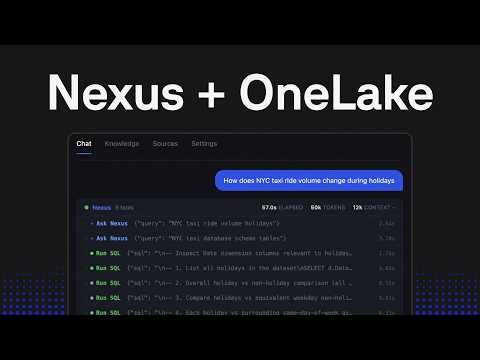
Pinecone Nexus Microsoft OneLake Integration demo
8:18
Tutorial8:18
Pinecone Nexus Microsoft OneLake Integration demo
A short walkthrough demonstrating the Pinecone Nexus integration with Microsoft OneLake. In this demo, Pinecone Staff Data Engineer Simon Lu showcases how easy it is to use Nexus to build a reliable, production-grade knowledge layer directly over structured data stored in Microsoft OneLake or a Fabric Data Warehouse. By creating an intuitive semantic layer, Nexus allows AI agents to accurately interpret complex enterprise schemas and answer business questions using natural language. What You'll Learn: The Setup (0:00): A look at the sample enterprise datasets in the Fabric console (Census, NYC Taxi, Holidays, and NYC 311 data). Connecting to Fabric (1:05): How to configure the connection using an Azure Service Principal and your SQL connection string. Adding Context Documents (1:55): How to upload markdown documentation, data dictionaries, or semantic models to bootstrap your knowledge base. Background Initialization (2:50): How the background agent explores tables, maps entity relationships, and automatically writes analytical data reports. Nexus in Action (3:42): A demo of the agentic chat playground handling complex, multi-table SQL queries from natural language prompts. Programmatic Access & Curation (4:54): How to integrate Nexus into your own agent workflows as a tool, and how to dynamically update the knowledge layer with feedback. Under the Hood (5:51): An inside look at the source page and the atomic knowledge artifacts Nexus generates to ensure consistent, highly accurate RAG performance. Learn more about the Pinecone Nexus integration with Microsoft Fabric: https://www.pinecone.io/newsroom/microsoft-onelake-nexus/
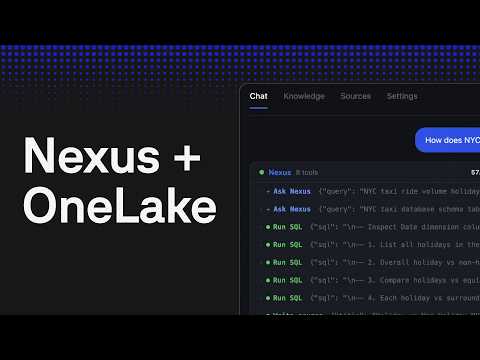
Pinecone Nexus integration with Microsoft OneLake short demo
1:53
Tutorial1:53
Pinecone Nexus integration with Microsoft OneLake short demo
A quick walkthrough demonstrating the Pinecone Nexus integration with Microsoft OneLake. Video Timeline: 0:00 - 0:08 | Setup & Connection: Connecting Nexus to Microsoft Fabric via Azure Service Principal and SQL endpoints using a sample enterprise dataset (Census, NYC Taxi, and 311 data). 0:08 - 0:24 | Bootstrapping the Knowledge Layer: Ingesting existing onboarding docs and launching an background agentic exploration loop that probes schemas, maps entity relationships, and analyzes data distributions. 0:26 - 1:04 | Agent Playground in Action: Watch a thin agentic layer leverage Nexus to accurately write SQL, cite its sources, and answer complex natural language questions over structured data. 1:06 - End | Knowledge Artifact Curation: A look inside the Nexus backend to see how raw data is pre-compiled into structured, atomic knowledge artifacts, domain documentations, and data quality caveats for deterministic retrieval. Learn more about the Pinecone Nexus integration with Microsoft Fabric: https://www.pinecone.io/newsroom/microsoft-onelake-nexus

Who uses it

Real use cases, no hype
Semantic Search
Build billion-scale semantic search with low latency and high recall across any data modality.
RAG Pipelines
Power retrieval-augmented generation with accurate, low-latency vector retrieval as context for LLMs.
Agent Memory
Provide isolated, persistent memory per agent using namespaces for scalable multi-agent systems.
Recommendation Engines
Deliver real-time personalized recommendations with metadata filtering and fast vector similarity.
Multi-Modal Search
Search across images, text, and audio by embedding them into a shared vector space.
Anomaly Detection
Detect outliers in real-time by measuring embedding distance from normal patterns.
Knowledge Engines
Offload retrieval and reasoning to a dedicated knowledge layer for agentic AI applications.
What's great
  • Fully managed vector database, zero ops
  • Consistent low latency at billion-vector scale
  • Automatic indexing without manual tuning
  • Rich ecosystem integrations with AI tools
Technical strengths
  • Serverless architecture scales storage and compute independently
  • Metadata filtering runs inline with vector search
  • Supports dense, sparse, and full-text search in one index
Where it falls short
  • Can become expensive at high query or write volumes
  • Limited customization of underlying index algorithms
  • Vendor lock-in for vector storage
  • No on-premise deployment option
Technical limitations
  • Write unit pricing may be high for ingestion-heavy workloads
  • No support for embedding custom models inside the database
  • Lower plan tiers cap index and namespace counts
For technical folks

The deep-dive specs

Architecture
Serverless vector database with distributed object storage
Indexing
Automatic, no tuning required
Write Acknowledgment
<100ms
Query Latency
31ms p50 at 1B vectors
Search Volume
Billion-vector scale
Supported Index Types
Dense, Sparse, Full-Text

FAQ

Includes technical Q&A
Pinecone's serverless architecture uses distributed object storage and automatically selects indexing algorithms per data size, scaling read/write capacity without manual intervention.

Traffic Insights

Monthly Visits

600K

September 2026

Growth Rate

0%

vs last month

Dominance

0%

in Search

Top Country

India

12% of traffic

Top Countries Breakdown

India
12%
Bangladesh
9%
Taiwan
6%
United Kingdom
5%

Growth Trend

Stable

Traffic has remained stable.

Honest pricing

No sneaky tiers, no “contact sales”

Here's who each plan is actually for — and where the hidden charges might hit.

Starter
Free/mo

Individuals

  • Free to start
  • Dense
  • Sparse
  • and Full-Text indexes
  • Up to 5 indexes
  • Up to 2GB storage
  • Up to 2M write units/mo
Builder
$20/mo

Teams

  • $20/month flat
  • 10 indexes per project
  • 1000 namespaces per index
  • Up to 10GB storage
  • Up to 5M write units/mo
  • 5 projects
Standard
Most picked
$50/mo

Business

  • Pay-as-you-go with $50/month minimum usage
  • Unlimited storage ($0.33/GB/mo)
  • Up to 20 indexes
  • 100000 namespaces per index
  • Dedicated Read Nodes
  • Backup and Restore
Enterprise
$500/mo

Enterprise

  • Pay-as-you-go with $500/month minimum usage
  • 99.95% Uptime SLA
  • Private Networking
  • Customer Managed Encryption Keys
  • Audit Logs
  • Service Accounts
  • Admin APIs
Reviews

What the internet actually thinks

Data refreshed weekly. No paid placements.

Trustpilot
Not reviewed yet
G2
G2
Not reviewed yet
C
Capterra
Not reviewed yet
Product Hunt
Not reviewed yet
COMMUNITY COMMENTS

Leave a Comment

Help others make informed decisions. Your honest feedback shapes the community's understanding of this tool.

Tips for commenting

  • Be specific about features you used
  • Share real use cases and results
  • Mention both pros and cons
  • Keep it honest and constructive
Sign in to leave a comment

Your comment will be published after moderation

Filter by rating:
Sort by:

No comments yet

Be the first to share your experience with this tool.

Alternatives

Not quite the right fit?

Here's what else is out there.

Detail tags
Found via these searches
#VectorDatabase#SemanticSearch#RAG#AI#MachineLearning#DeveloperTools