Paradox

Paradox

Paradox is an AI-powered conversational platform designed to automate high-volume hiring tasks. Its AI assistant, Olivia, handles candidate screening, interview scheduling, and communication via SMS, chat, and web interfaces, significantly reducing time-to-apply and improving candidate experience. It supports over 100 languages and integrates with major ATS systems like Workday and SAP. Targeted at HR teams, recruiters, and hiring managers across industries such as retail, healthcare, and hospitality, Paradox offers analytics, customizable assistants, and compliance features to streamline recruitment. It aims to automate repetitive tasks so recruiters can focus on building relationships with talent.

Chatbots
Visit website
Added on
Sep 30, 2026
Conversational AIHiring AutomationMobile-FirstSMS ChatMultilingualATS IntegrationSecureGlobal ScaleCandidate Experience
Product information

Everything worth knowing about Paradox

The complete picture — from everyday features to the technical detail builders and IT folks dig for.

Core features

What it actually does

Conversational Apply
Instantly connect great talent with the right opportunities.
Conversational Scheduling
Let candidates choose the best time slot that works for everyone.
Multilingual Support
Respond instantly in 100+ languages for candidate interactions.
Candidate Feedback Surveys
Collect candidate feedback throughout the hiring journey.
Personalized Assistant
Customize the voice, tone, and photo of your assistant to represent your brand.
Technical capabilities
Natural Language Processing
Uses NLP to understand candidate intent and nuances beyond simple chatbot responses.
Multi-Platform Messaging
Supports interactions via SMS, WhatsApp, and web chat for candidate engagement.
Must watch videos
The paradox at the heart of AI and science | Terence Tao
30:11
Tutorial30:11
The paradox at the heart of AI and science | Terence Tao
Become a Big Think member to unlock expert classes, premium print issues, exclusive events and more: https://bigthink.com/membership/?utm_source=youtube&utm_medium=social&utm_campaign=membership&utm_content=btclips-ytdesc-text-seg-tao-svl_1upFpQo Terence Tao has spent decades solving problems which he likens to great adventures where one might take a wrong turn or see a cliff that can't yet be reached. Now, Tao watches as AI takes the journey for us, creating greater possibility in math and science. But, that possibility costs us something. Watch Terence Tao's Full Interview ►https://www.youtube.com/watch?v=OOMx2BHHWtE ---------------------------------------------------------------------------------- About Terence Tao: Terence Tao was born in Adelaide, Australia, where he excelled at university-level math by age nine and became, at 13, the youngest-ever gold medalist at the International Mathematical Olympiad. He earned his PhD from Princeton at 20 and joined UCLA's mathematics faculty, becoming the university's youngest-ever tenured professor at 24. In 2006 he won the Fields Medal for contributions spanning partial differential equations, combinatorics, harmonic analysis, and additive number theory, and he remains a UCLA professor today, known for prolific, wide-ranging work including the Green–Tao theorem on prime number progressions.
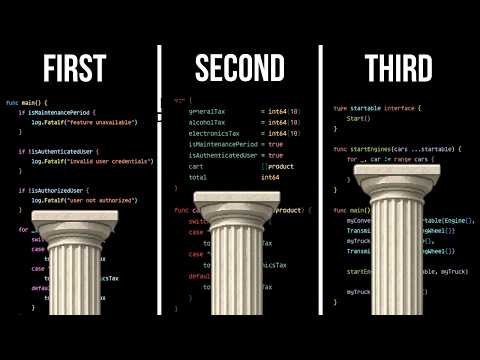
The Paradox of Why AI Code Is Failing Us - 3 Pillars
17:17
Tutorial17:17
The Paradox of Why AI Code Is Failing Us - 3 Pillars
An in-depth technical breakdown of the paradox surrounding AI-generated code, software demand elasticity, and why large language models struggle when scaling enterprise codebases. In this video, we explore the economic backdrop of Jevons Paradox in software engineering, examine how transformer attention mechanisms process tokens, and break down the 3 core architectural failure modes limiting AI code generation. TIMESTAMPS: 00:00 - The Problem: AI Generates Too Much Code 01:04 - Demand Elasticity & Software Features 04:00 - Jevons Paradox in Software Development 04:48 - How AI Reads Code: Tokens & High-Dimensional Vectors 08:01 - The Attention Mechanism & Context Windows 10:19 - Pillar 1: Context Window Limits & Quadratic Scaling (O(n²)) 14:13 - Pillar 2: Sparse Attention & Missed Connections 15:02 - Pillar 3: Retrieval (RAG) & Decoupled Index Blind Spots 16:32 - The Self-Reinforcing Loop & Conclusion
Unfortunately, You Need to Know What the Jevons Paradox is
33:22
Tutorial33:22
Unfortunately, You Need to Know What the Jevons Paradox is
One thing I think a lot AI boosters get wrong is that they think AI will be good at creating new, quality information while, at the moment, the only thing it has shown utility at is organizing existing information. Even the weights themselves are a kind of distillation of existing information. Much of science...perhaps even the great majority of it, is not organizing existing information, it is acquiring new information. AI might make that more efficient, but it does not do it. This is one of the things that writing this video made me think. I look forward to other people's thoughts in the comments. Video edited by Milo Erbach - https://miloportfolio.carrd.co/

Who uses it

Real use cases, no hype
High-Volume Hourly Hiring
Automate apply, screen, and schedule for frontline workers in retail, restaurant, or healthcare.
Interview Scheduling
Let candidates choose interview times via conversational AI, reducing admin work.
Candidate Screening
Validate qualifications upfront through chat or text interactions.
Onboarding Automation
Instantly send new hire documents and tasks for Day 1 readiness.
Hiring Events
Manage registration, reminders, and follow-up for in-person or virtual events.
Multilingual Recruitment
Engage candidates automatically in over 100 languages to broaden reach.
Analytics and Reporting
Track 1000+ hiring metrics with dashboards to optimize strategies.
What's great
  • Automates high-volume hiring tasks like screening and scheduling
  • Seamless integration with major ATS (Workday, SAP)
  • Multilingual support in 100+ languages
Technical strengths
  • Advanced NLP for intent understanding beyond chatbots
  • Open API for custom integrations with HR tech stacks
Where it falls short
  • Acts as overlay, not a full ATS replacement
  • Reliant on SMS/chat engagement, may not suit all candidates
  • Potentially high cost for enterprise features
Technical limitations
  • Integration setup with legacy systems can be complex
  • AI may struggle with highly nuanced candidate scenarios
For technical folks

The deep-dive specs

AI Technology
Natural Language Processing (NLP) for conversational understanding
Candidate Language Support
100+ languages
User Interface Languages
30+ languages

FAQ

Includes technical Q&A
Paradox is a conversational recruiting platform launched in 2016, using AI assistant Olivia to automate hiring tasks like screening and scheduling for recruiting teams.

Traffic Insights

Monthly Visits

—

October 2026

Growth Rate

0%

vs last month

Dominance

0%

in Chatbots

Top Country

—

Top Countries Breakdown

—

Growth Trend

Stable

Traffic has remained stable.

Pricing overview
Paid Pricing

Paradox Pricing

Paradox uses a paid pricing structure. Real-time rates, custom enterprise quotas, and plan details are managed directly on their official platform.

Check Pricing on Paradox
Reviews

What the internet actually thinks

Data refreshed weekly. No paid placements.

Trustpilot
Not reviewed yet
G2
G2
Not reviewed yet
C
Capterra
Not reviewed yet
Product Hunt
Not reviewed yet
COMMUNITY COMMENTS

Leave a Comment

Help others make informed decisions. Your honest feedback shapes the community's understanding of this tool.

Tips for commenting

  • •Be specific about features you used
  • •Share real use cases and results
  • •Mention both pros and cons
  • •Keep it honest and constructive
to leave a comment

Your comment is published immediately.

Filter by rating:
Sort by:

No comments yet

Be the first to share your experience with this tool.

Alternatives

Not quite the right fit?

Here's what else is out there.