Databricks

Databricks

Databricks is a cloud-based data and AI platform that unifies data engineering, data science, and business analytics. Built on a lakehouse architecture, it provides a single environment for processing massive datasets, building machine learning models, and deploying generative AI applications. Key capabilities include serverless data warehousing, ETL pipelines, Unity Catalog for governance, and tools for building AI agents and applications. Targeted at data engineers, data scientists, ML engineers, and analytics teams, Databricks eliminates data silos and simplifies the AI/ML lifecycle. It offers pay-as-you-go pricing based on compute usage (DBUs) and integrates natively with AWS, Azure, and GCP.

Analytics
Visit website
Added on
Sep 22, 2026
Monthly Visits
4.4M
Data Lakehouse PlatformMulti-Cloud (AWS/Azure/GCP)DBU-based BillingAI/ML IntegratedServerless WarehousingUnity Catalog Governance
Product information

Everything worth knowing about Databricks

The complete picture — from everyday features to the technical detail builders and IT folks dig for.

Core features

What it actually does

Unified Data, Analytics, and AI Platform
A single platform for data engineering, warehousing, BI, AI/ML, and governance, eliminating silos.
Pay-As-You-Go Usage
No up-front costs; pay only for compute resources used at per-second granularity.
Committed Use Contracts
Access discounts and benefits by committing to certain usage levels across multiple clouds.
Multi-Cloud Support
Run workloads on AWS, Azure, or GCP with a consistent platform experience.
Technical capabilities
Databricks Unit (DBU) Billing
Usage is measured and billed in normalized units of processing power called DBUs.
Per-Second Billing Granularity
Compute costs are tracked and billed at per-second intervals for precise cost control.
Must watch videos
Databricks for Good x MapAid: Creating a Searchable Database for Groundwater Discovery
2:37
Tutorial2:37
Databricks for Good x MapAid: Creating a Searchable Database for Groundwater Discovery
How Databricks for Good helped MapAid leverage AI to transform static archives into an actionable search engine for Sudan’s water crisis.
How Databricks Genie Automates Data Workflows with Genie Ontology and Scheduled Tasks
2:41
Tutorial2:41
How Databricks Genie Automates Data Workflows with Genie Ontology and Scheduled Tasks
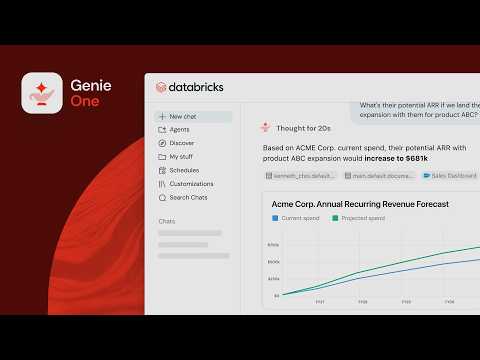
Databricks Genie streamlines workflows from setup to automated execution, connecting business context, file uploads, Unity Catalog data, collaboration, and scheduled automation in one experience. Youssef Mrini (Developer Advocate) walks through the latest Genie One updates. Genie carries context forward: Genie Ontology maps your business data, workspace instructions apply org conventions to every prompt, and scheduled tasks automate recurring work with shareable outputs. Built for business users, analysts, and data teams moving from ad hoc questions to repeatable, governed workflows across web, desktop, and mobile. In this video: • Context: Genie Ontology enabled by default, plus workspace instructions for org data conventions and response guidelines • Files: Upload Word, images, CSVs, and spreadsheets; PDFs parse asynchronously in the background • Unity Catalog: Query tables, preview schema, and request access in one click • Collaboration: @mention teammates in threads; export reports to PDF for stakeholders • MCP writes (Beta): Perform write actions in external apps, governed by Unity Catalog and user auth • Automation: Scheduled tasks reference past runs; recurring updates include visualizations and PDF attachments • Access anywhere: New macOS desktop app; mobile supports scheduled tasks, dev/prod toggle, and VPN login • Organization: Pin and rename chats in the sidebar Several features are in Beta or Public Preview. Workspace admins can manage access from the Previews page. Learn more about the latest updates in Genie One: https://docs.databricks.com/aws/en/ai-bi/release-notes/2026 Chat in Genie One: https://docs.databricks.com/aws/en/genie-one/chat Genie Ontology: https://docs.databricks.com/aws/en/genie/genie-ontology Desktop app: https://docs.databricks.com/aws/en/genie-one/desktop MCP connections and writes: https://docs.databricks.com/aws/en/genie-one/external-sources Chapters 00:00 - Introduction & Context Setup 00:35 - Document Uploads & Unity Catalog Integration 01:10 - Collaboration & Workspace Execution 01:40 - Automated Workflows & Scheduling 02:01 - Desktop & Mobile Apps
Genie One Beginner's Guide: Explore Data & Automate Tasks
5:51
Tutorial5:51
Genie One Beginner's Guide: Explore Data & Automate Tasks
Master the basics of Genie One for exploring company data, building visualizations, creating documents, and automating repetitive tasks. Learn more about Genie One: https://www.databricks.com/product/genie/one Chapters: 0:00 - Introduction 1:00 - Ask a question 1:27 - Reviewing Genie Ontology snippets 4:50 - Creating a chart and document from a single prompt 5:40 - Schedule an ongoing email alert

Who uses it

Real use cases, no hype
Unified Data Platform
Consolidate batch and streaming data pipelines, warehousing, and AI workloads on a single Lakehouse architecture.
AI Agent Development
Build and deploy production-ready AI agents grounded in governed enterprise data using Mosaic AI.
Real-Time Analytics
Create interactive dashboards and conversational analytics with AI-powered BI tools like Genie.
Serverless App Development
Develop and scale secure data and AI applications with Lakebase, a serverless Postgres database.
Data Governance & Security
Implement unified governance across data, models, and agents with Unity Catalog.
Cloud Cost Optimization
Reduce total cost of ownership by eliminating legacy warehouse silos and optimizing compute usage.
Data Sharing & Marketplace
Access and share data, analytics, and AI assets across organizational boundaries via a secure marketplace.
What's great
  • Unified platform for data, analytics, and AI workloads
  • Pay-as-you-go with no up-front costs
  • Trusted by Fortune 500 companies
  • Serverless database (Lakebase) for apps and agents
Technical strengths
  • Deep integration with Unity Catalog for governance
  • Built on open-source innovations (Spark, Delta Lake)
Where it falls short
  • Complex pricing model with multiple SKUs and cloud variations
  • Requires commitment for best discounts, which may be costly upfront
  • Vendor lock-in risk despite open-source foundation
  • Azure Databricks pricing managed by Microsoft, not directly
Technical limitations
  • DBU-based billing can be opaque without careful monitoring
  • Cloud infrastructure costs are separate and can surprise
For technical folks

The deep-dive specs

FAQ

Includes technical Q&A
Free access to the Databricks platform to manage data, analytics, and AI. Cloud resource costs (compute, storage) are separate and billed by your provider.

Traffic Insights

Monthly Visits

4.4M

November 2026

Growth Rate

0%

vs last month

Dominance

0%

in Analytics

Top Country

United States

31% of traffic

Top Countries Breakdown

United States
31%
India
12%
Brazil
6%
Bangladesh
5%
United Kingdom
5%

Growth Trend

Stable

Traffic has remained stable.

Pricing overview
Freemium Pricing

Databricks Pricing

Databricks uses a freemium pricing structure. Real-time rates, custom enterprise quotas, and plan details are managed directly on their official platform.

Check Pricing on Databricks
Reviews

What the internet actually thinks

Data refreshed weekly. No paid placements.

Trustpilot
Not reviewed yet
G2
G2
Not reviewed yet
C
Capterra
Not reviewed yet
Product Hunt
Not reviewed yet
COMMUNITY COMMENTS

Leave a Comment

Help others make informed decisions. Your honest feedback shapes the community's understanding of this tool.

Tips for commenting

  • •Be specific about features you used
  • •Share real use cases and results
  • •Mention both pros and cons
  • •Keep it honest and constructive
to leave a comment

Your comment is published immediately.

Filter:
Sort:

No comments yet

Be the first to share your experience with this tool.

Alternatives

Not quite the right fit?

Here's what else is out there.