Baseten

Baseten

Baseten is a cloud platform for deploying, managing, and scaling AI model inference and training. It provides optimized runtimes for open-source, custom, and fine-tuned models, with features like auto-scaling, multi-cloud deployment, and observability. Targeted at ML engineers, developers, and AI founders building production-grade applications, it supports various modalities including LLMs, embeddings, image generation, and text-to-speech. The platform offers Model APIs for instant access to hosted models via an OpenAI-compatible interface, dedicated inference for custom deployments on purpose-built infrastructure, and training capabilities via Loops (for fine-tuning) or custom Training Jobs. It handles containerization, GPU capacity management, scaling, and production operations like logging and metrics.

Productivity
Visit website
Added on
Sep 22, 2026
Multi-Cloud DeploymentCustom DockerTensorRT-LLM EngineMoE InferenceOpenAI-Compatible APITraining & Fine-Tuning
Product information

Everything worth knowing about Baseten

The complete picture — from everyday features to the technical detail builders and IT folks dig for.

Core features

What it actually does

Model APIs (Hosted Models)
Call a curated set of hosted models (like GLM-5.3, DeepSeek V4, Kimi K3) via an OpenAI-compatible API for instant prototyping and evaluation without deployment.
Dedicated Inference Deployments
Deploy your own open-source, fine-tuned, or custom models on dedicated GPU infrastructure with full control over hardware, autoscaling, and release lifecycle.
Multi-Cloud & Hybrid Hosting
Scale workloads globally across any cloud provider. Options include fully-managed Baseten Cloud, single-tenant clusters, or self-hosted deployments in your own VPCs.
Optimized Inference for Key Modalities
Get out-of-the-box performance optimizations for core Gen AI workloads: rapid image generation, optimized transcription, state-of-the-art text-to-speech, and high-performance LLM runtimes.
Technical capabilities
Purpose-Built Inference Engines
Utilize specialized engines for supported architectures: Engine-Builder-LLM (TensorRT-LLM compilation), BIS-LLM (MoE models), and BEI (embeddings/reranking).
Training (Loops & Jobs)
Train models using either Loops (for fine-tuning/RL on supported models) or Training Jobs (run your own framework code on dedicated GPU clusters) and deploy checkpoints.
Production Observability & Ops
Built-in logs, metrics, request traces, autoscaling, and environment promotion (dev/staging/prod) with export options to Datadog, Prometheus, Grafana, or New Relic.
Must watch videos
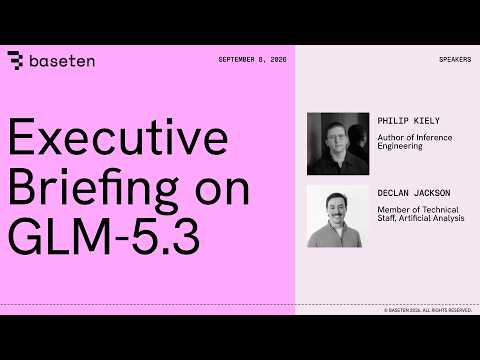
Executive Briefing on GLM-5.3
59:56
Tutorial59:56
Executive Briefing on GLM-5.3
In this live webinar, Philip Kiely, Author of Inference Engineering at Baseten, and Declan Jackson, Member of Technical Staff at Artificial Analysis, break down GLM-5.3 — the new leading open-weight model — and how to decide whether it belongs in your stack. GLM-5.3 scores 45 on the Artificial Analysis Intelligence Index, ahead of every other open-weight model, while its sibling GLM-5.3 Flash sits on the cost-per-task Pareto frontier at roughly a quarter the price of closed models at the same intelligence level. Philip and Declan walk through the benchmark methodology behind those numbers, where each model is strong and weak, what it actually costs to run them, and how to use the two together in production. 0:00 Welcome & GLM-5.3 Overview 2:59 Introductions: Baseten & Artificial Analysis 4:39 The Open-Weight Model Adoption Curve 6:05 GLM-5.3 and 5.3 Flash: Release, License & Size 8:54 Two Architectures & Z.ai's Next Move 12:15 How Artificial Analysis Benchmarks the AI Stack 14:30 Intelligence Index: GLM-5.3 Leads Open Weights 15:32 What Changed in Intelligence Index v4.3 17:22 The 3-to-9 Month Gap to the Closed Frontier 19:14 Cost Per Task & the Pareto Frontier 22:43 Time Per Task: Why Your Provider Matters 25:12 Agentic Strengths: Knowledge Work & Coding 27:23 Where GLM-5.3 Is Weak: Knowledge & Vision 30:18 Inside AA Briefcase: Rubrics, Analysis & Presentation Elo 34:41 Using GLM-5.3 and Flash Together 36:01 Comparing Real Outputs: 5.2 vs 5.3 vs Flash 37:06 Why Elo Works for Subjective Quality 39:44 Cost Per Task in Practice: 87 Cents vs $6 41:46 Field Use Cases: Coding, Post-Training & Scale 44:18 Inference Engineering: Fast Mode & Grafted Vision 46:38 Audience Poll & Live Q&A Begins 49:17 Interpreting the AA Intelligence Index 51:22 What a Pareto Frontier Actually Tells You 53:17 Best Tasks for Flash vs Max 55:05 Out-There Uses: 3D, Blender & Voice Agents 56:08 Does the Harness Change Model Scores? 57:59 How to Try and Fine-Tune GLM-5.3 58:37 Closing & Where to Follow Up Try GLM-5.3 on Baseten now: https://www.baseten.co/library/glm-5-3 Explore the benchmarks on Artificial Analysis: https://artificialanalysis.ai Baseten is the fastest way to build, deploy, and scale performant AI-powered applications. Check us out here: https://www.baseten.co
Baseten presents Notion
2:45
Tutorial2:45
Baseten presents Notion
What if all your meetings were automatically recorded in the same place your knowledge base lives? Notion AI Meeting notes transcribes meetings and generates summaries automatically. Baseten built a custom, streaming transcription and diarization pipeline tailored to Notion’s exact workload. Try Notion now: www.Notion.com Baseten is the fastest way to build, deploy, and scale performant AI-powered applications. Check us out here: https://www.baseten.co
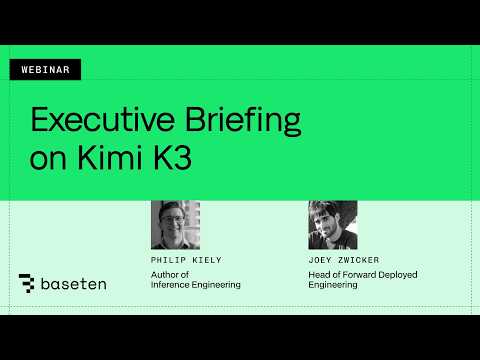
What is Kimi K3? Executive briefing
58:28
Tutorial58:28
What is Kimi K3? Executive briefing
In this live webinar, Joey Zwicker, Head of Forward Deployed Engineering, and Philip Kiely, Author of Inference Engineering, present a tactical briefing on everything you need to know about the latest frontier open model, Kimi K3. Kimi K3 is the most intelligent open model to date, but it is also the largest, at 2.8T parameters. Joey and Philip show how to apply proven strategies for evaluating and implementing Kimi K3 including: serving the model, benchmarking its capabilities, and evaluating per-task cost in the specific context of your workloads and applications. 0:00 Welcome & Kimi K3 Overview 2:37 Agenda & How to Evaluate Frontier Models 4:38 The Evolution of Open-Weight LLMs 8:27 Why Kimi K3 Matters 12:29 Benchmark Performance & Model Comparisons 14:29 How Enterprises Should Evaluate AI Models 18:05 Live Demo: Kimi K3 in Action 22:38 Cost, Efficiency & Choosing the Right Model 28:11 Multi-Model Routing & Production Strategies 31:44 Live Q&A Begins 33:30 Enterprise AI Use Cases Beyond Coding 37:41 KDA Attention Explained 40:06 Future Kimi Roadmap 42:20 Building Multi-Model AI Systems 43:37 Inference Performance, KV Cache & NVIDIA Dynamo 46:03 Fine-Tuning & Quantization 49:02 Common Implementation Mistakes 51:24 What Makes AI Products Successful? 53:56 Enterprise Adoption & Open Models 57:22 Final Takeaways & Closing Try Kimi K3 on Baseten now: https://www.baseten.co/library/kimi-k3 Baseten is the fastest way to build, deploy, and scale performant AI-powered applications. Check us out here: https://www.baseten.co

Who uses it

Real use cases, no hype
Production LLM Serving
Deploy fine-tuned or open-source language models (like Qwen, DeepSeek, GLM) with optimized runtimes for high throughput and low latency.
Real-time Transcription
Power speech-to-text applications with the fastest, most accurate Whisper-based inference and sub-300ms latency.
High-Volume Embeddings
Scale vector search and RAG systems with Baseten Embeddings Inference (BEI), offering 2x higher throughput than alternatives.
Custom Model Deployment
Containerize and deploy proprietary or custom models (image gen, TTS, etc.) on dedicated GPUs with full control over autoscaling.
Model Fine-tuning & RL
Use the Loops SDK for supervised fine-tuning or reinforcement learning on supported base models, then deploy checkpoints directly.
Compound AI Orchestration
Chain multiple models or steps with Baseten Chains for granular hardware control, achieving 6x better GPU utilization.
Prototyping with Model APIs
Instantly test and evaluate the latest hosted models (like Kimi K3) via an OpenAI-compatible API without deployment.
What's great
  • Blazing-fast cold starts & 99.99% uptime
  • Seamless OpenAI-compatible API for hosted models
  • Multi-cloud flexibility (AWS, GCP, self-hosted)
  • SOC 2 Type II & HIPAA compliance baked in
Technical strengths
  • BIS-LLM engine for optimized MoE model routing
  • Baseten Embeddings Inference (BEI) for 2x embedding throughput
  • Automatic TensorRT-LLM compilation via Engine-Builder-LLM
Where it falls short
  • Pricing not transparent on homepage
  • Primary focus is AI inference, not general compute
  • Self-hosted option may require significant operational overhead
Technical limitations
  • Model library curated, not open for arbitrary frameworks without custom Docker
  • Advanced performance optimizations are tied to their proprietary engine stack
  • Loops training SDK is limited to supported base models
For technical folks

The deep-dive specs

FAQ

Includes technical Q&A
Model APIs are pre-optimized, hosted endpoints for a curated set of models you call via API without managing infrastructure. Dedicated Inference is for deploying your own custom, fine-tuned, or open-source models on dedicated GPU clusters that you fully control.

Traffic Insights

Monthly Visits

—

October 2026

Growth Rate

0%

vs last month

Dominance

0%

in Productivity

Top Country

—

Top Countries Breakdown

—

Growth Trend

Stable

Traffic has remained stable.

Pricing overview
Freemium Pricing

Baseten Pricing

Baseten uses a freemium pricing structure. Real-time rates, custom enterprise quotas, and plan details are managed directly on their official platform.

Check Pricing on Baseten
Reviews

What the internet actually thinks

Data refreshed weekly. No paid placements.

Trustpilot
Not reviewed yet
G2
G2
Not reviewed yet
C
Capterra
Not reviewed yet
Product Hunt
Not reviewed yet
COMMUNITY COMMENTS

Leave a Comment

Help others make informed decisions. Your honest feedback shapes the community's understanding of this tool.

Tips for commenting

  • •Be specific about features you used
  • •Share real use cases and results
  • •Mention both pros and cons
  • •Keep it honest and constructive
to leave a comment

Your comment is published immediately.

Filter by rating:
Sort by:

No comments yet

Be the first to share your experience with this tool.

Alternatives

Not quite the right fit?

Here's what else is out there.