Recursion

Recursion

Recursion is a clinical-stage TechBio company leveraging AI, automation, and massive datasets to decode biology and accelerate drug discovery. Its core platform, the Recursion OS, is an integrated system connecting automated wet labs generating petabytes of phenomic and transcriptomic data with supercomputing power to train predictive models. This end-to-end approach is designed to dramatically reduce the time and cost of bringing new treatments from target identification to clinical trials. The company focuses on diseases with high unmet need, including oncology, rare diseases, and neuroscience, with multiple clinical-stage programs. By industrializing R&D with a 'lab-in-the-loop' model, Recursion aims to overcome the high failure rates of traditional pharmaceutical research and deliver better medicines to patients.

Search
Visit website
Added on
Sep 19, 2026
AI drug discoveryRecursion OSPhenomicsAutomated labs50PB datasetSupercomputerOpen-source models
Product information

Everything worth knowing about Recursion

The complete picture — from everyday features to the technical detail builders and IT folks dig for.

Core features

What it actually does

End-to-End AI Drug Discovery Platform
An integrated system (Recursion OS) connecting automated wet labs, proprietary data, and AI models to go from target identification to clinical candidates.
Massive Proprietary Dataset
A 50+ petabyte dataset built from running up to 2.2 million experiments weekly, forming the foundation for training AI models.
AI-Powered Disease Biology Mapping
Uses AI to analyze phenomic and transcriptomic data to create 'Maps of Biology' for discovering new disease mechanisms and drug targets.
Clinical Pipeline of Investigational Medicines
Advances a portfolio of potential treatments for high unmet need conditions, including 5 programs in oncology and rare disease.
Technical capabilities
Industrial-Scale Automated Lab Infrastructure
Highly automated labs ensure standardized, high-quality data generation at an industrial scale, reducing human error and experimental variation.
BioHive-2 Supercomputer
One of the most powerful supercomputers wholly owned by a biopharma company, used to train large foundation models and power the 'World Model'.
Must watch videos
Advancing AI Cancer Drug REC-1245 to Clinical Trials
2:13
Tutorial2:13
Advancing AI Cancer Drug REC-1245 to Clinical Trials
REC-1245 – Recursion’s first program to reach clinical studies that derived from our AI-enabled Maps of Biology -- is currently in Phase 1/2 clinical trials for patients with select solid tumors and lymphoma. REC-1245 is a potentially first-in-class, potent and selective RBM39 degrader. Preclinical data supports that RBM39 degradation induces splicing defects which downregulate DNA damage response (DDR) networks and cell cycle checkpoints. The Recursion AI-Enabled Breakthrough to discover RBM39: Using our AI-enabled Maps of Biology – which allow us to screen millions of predicted biological and chemical relationships – we identified RMB39 as a novel target which looks functionally similar to the well-known but hard to drug target CDK12. Key Differences in RBM39 vs CDK12 CDK12 is a well-known, yet challenging, cancer target. Many investigational drugs designed to target CDK12 unfortunately also inhibit structurally similar CDK13, resulting in significant toxicity. We leveraged the Recursion OS, exploring predicted relationships across the entire genome and chemical compounds to identify the novel target relationship of RBM39, which our maps suggest has similar biological function to CDK12. Using our platform, we then identified and optimized small molecules, including our candidate molecule REC-1245, that targets RBM39 and has similar effects to loss of CDK12 without affecting CDK13. Significantly Faster than Industry: We progressed from target discovery to IND enabling studies (the step before potential clearance to enter the clinic) in under 18 months – more than twice as fast as the industry average. The Phase 1/2 DAHLIA clinical trial is evaluating the safety, tolerability, pharmacokinetics, pharmacodynamics, and potential monotherapy efficacy of REC-1245 in solid tumor indications and lymphoma, with multiple biomarkers being explored.. We estimate that the initially addressable population for this potential therapeutic will be over 100,000 patients in the US and EU5. Learn more: https://ir.recursion.com/news-releases/news-release-details/recursion-reports-first-quarter-financial-results-and-provides
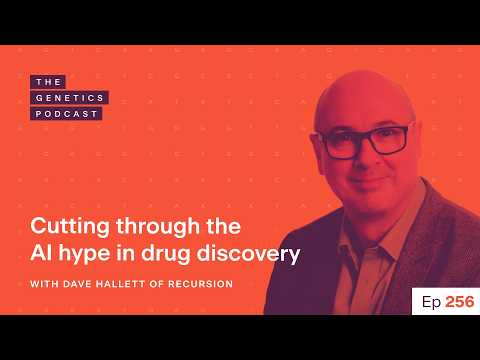
Cutting through the AI Hype in Drug Discovery - Recursion CSO Dave Hallett on the Genetics Podcast
1:19
Tutorial1:19
Cutting through the AI Hype in Drug Discovery - Recursion CSO Dave Hallett on the Genetics Podcast
A clip from Recursion CSO Dave Hallett's conversation with Patrick Short, CEO of Sano Genetics, host of The Genetics Podcast, about the real gains and remaining hurdles for AI drug discovery and development. Drawing on his nearly 30 year experience, beginning at Merck in the mid-1990s, Dave shared how AI has fundamentally changed what’s possible – from research capabilities, to molecule design, to clinical trial planning – but noted that it still can’t change the laws of physics. 🔹Highlights include: ▪️How AI has allowed for true multi-parameter optimization Dave said the shift from single-parameter to true multi-parameter optimization is the biggest change he's seen at the bench. A person can hold roughly six or seven variables in their head at once, he said; a computational system can track far more, without recency bias, across active learning loops. The result: "AI has massively compressed the time and the cost that's required to get from an idea to a candidate." Recursion has seen that show up as roughly 80% reductions in compounds made and 50-70% cuts to time-to-candidate on affected programs. ▪️Simulating trials before running them Rather than copying existing clinical trial protocols, Dave shared how Recursion pressure tests inclusion and exclusion criteria through simulation before a study launches — asking which criteria are actually still fit for purpose. Applied to REC-7735, evaluated in the ZINNIA trial, that process expanded the pool of patients the trial could reach by approximately 20%. ▪️Looking forward with pragmatism and optimism Dave was candid about AI’s limitations, too, noting that the industry is "still a long way" from modeling emergent human pathophysiology at the organism scale. He also discussed Recursion's partnership work on the breakthrough neuro map, and offered advice to early-career scientists: build deep domain expertise while remaining "bilingual" across biology, chemistry, and computation. 👉 Check out the full conversation: https://www.youtube.com/watch?v=BD34s2h64lU #techbio #AIdrugdiscovery #clinicaltrials #biotech #genomics
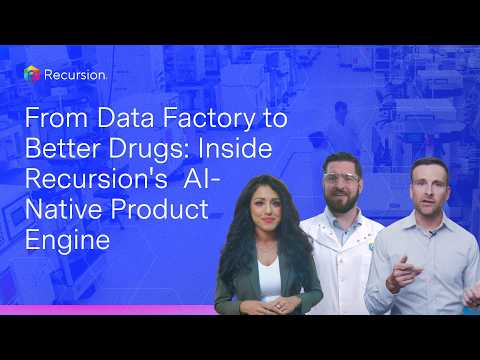
From Data Factory to Better Drugs: Inside Recursion's AI-Native Product Engine
16:09
Comparison16:09
From Data Factory to Better Drugs: Inside Recursion's AI-Native Product Engine
Behind the scenes of Recursion’s AI-native data factory and product engine – the first, and one of the largest, of its kind. CHAPTERS 0:00 — Introduction: Mapping the Haystack Reframing drug discovery from single-hypothesis testing to systematically mapping all of biology; an intro to Recursion's AI-native data factory and recursive learning loop. 1:24 — Building Disease-Relevant Cells at Scale Growing iPSC-derived human neurons at unprecedented scale (over 1 trillion neurons) using protocols developed with Roche/Genentech. 2:26 — Manipulating Cells at the Genetic Level Inside the lab: the Echo acoustic liquid handler, CRISPR-based perturbations, and running up to 2 million experiments a week with intentional randomization. 3:27 — Capturing High-Dimensional Data Imaging and sequencing cells at scale to generate reusable, future-proofed data that trains foundation models. 4:42 — Creating Maps of Biology How foundation models turn perturbations into "fingerprints" and build a searchable map of biology to generate disease hypotheses. 5:59 — Validating Hypotheses at the Bench Closing the loop: de-risking AI-generated hypotheses against the same bar pharma partners hold their own programs to. 6:37 — Designing Molecules with Centaur Introducing the AI-native chemistry engine — generative de novo design, and the ~90%-fewer-compounds efficiency stat. 7:58 — Exploring Novel Chemical Space How tools like Nesso-1 and AI retrosynthesis expand what a chemist can design and predict, compressing a full design cycle to about a day. 9:12 — Automated Design-Make-Test Labs Recursion's chemistry design platform performs automated synthesis, purification, and digital tracking in one connected system. 10:09 — Automated Testing and the Feedback Loop Plain-language experiment requests, halved pharmacology costs, and closing the loop between prediction and synthesis. 11:08 — Entering the Clinic: Introducing ClinTech Bringing the same data-driven approach into clinical development, starting with patient selection. 11:24 — Predicting Patient Response with Cardinal AI Matching lab-tested cancer cells to real patient tumors to predict benefit — and uncovering biomarkers. 12:25 — Solving the Enrollment Bottleneck How the Site Finder tool uses real-world data to identify trial sites and improve enrollment rates by 30–60%. 13:25 — Real-Time Trial Decision-Making The ClinTech biometrics engine speeding up dose-escalation decisions and contextualizing results against real-world evidence. 14:55 — Closing: The Recursive System in Practice Recap of Recursion's end-to-end AI product engine and its role in accelerating medicines already in the clinic today. #AI #drugdiscovery #drugdesign #biology #chemistry #TechBio #AIdrugdiscovery

Who uses it

Real use cases, no hype
Accelerated Drug Discovery
Use Recursion's platform to rapidly identify novel drug candidates and mechanisms of action for complex diseases.
Phenomic Analysis at Scale
Leverage automated, high-throughput imaging and analysis to map cellular responses to perturbations for target discovery.
AI-Driven Target Validation
Utilize proprietary Maps of Biology and Chemistry to de-risk and validate therapeutic targets with high confidence.
Generative De Novo Chemistry
Apply AI models to design novel molecular structures with desired properties and predicted safety profiles.
Clinical Trial Optimization
Use ClinTech tools to optimize trial design, site selection, and evidence generation for faster, more efficient studies.
Rare Disease Research
Apply the platform to uncover novel insights and develop therapies for diseases with small patient populations and limited data.
What's great
  • End-to-end AI-first approach drastically accelerates discovery timelines.
  • Strong partnerships with major pharma and tech companies (Roche, NVIDIA, etc.).
  • Publicly releasing open-source datasets and models to advance the field.
  • Focus on high-unmet-need areas like oncology and rare diseases.
Technical strengths
  • Massive, proprietary biological dataset for training AI models.
  • Industrial-scale, automated lab network generates standardized, high-quality data.
  • Full-stack, integrated platform from biology to clinical trial design.
Where it falls short
  • No publicly approved drugs yet; all pipeline programs are investigational.
  • Platform's full power is not accessible as a standalone SaaS for external developers.
  • Unproven at commercial scale; highly dependent on clinical trial success.
  • Dependence on strategic partners for key capabilities (e.g., patient data from Tempus).
Technical limitations
  • Extremely high capital expenditure for supercomputing and automated labs.
  • Publicly released data/models represent <1% of the full proprietary dataset.
  • Success relies on complex integration of many proprietary hardware/software systems.
For technical folks

The deep-dive specs

FAQ

Includes technical Q&A
Recursion is a clinical-stage TechBio company using an AI-native platform (Recursion OS) to decode biology and discover new medicines faster, focusing on oncology and rare diseases.

Traffic Insights

Monthly Visits

—

October 2026

Growth Rate

0%

vs last month

Dominance

0%

in Search

Top Country

—

Top Countries Breakdown

—

Growth Trend

Stable

Traffic has remained stable.

Pricing overview
Paid Pricing

Recursion Pricing

Recursion uses a paid pricing structure. Real-time rates, custom enterprise quotas, and plan details are managed directly on their official platform.

Check Pricing on Recursion
Reviews

What the internet actually thinks

Data refreshed weekly. No paid placements.

Trustpilot
Not reviewed yet
G2
G2
Not reviewed yet
C
Capterra
Not reviewed yet
Product Hunt
Not reviewed yet
COMMUNITY COMMENTS

Leave a Comment

Help others make informed decisions. Your honest feedback shapes the community's understanding of this tool.

Tips for commenting

  • •Be specific about features you used
  • •Share real use cases and results
  • •Mention both pros and cons
  • •Keep it honest and constructive
to leave a comment

Your comment is published immediately.

Filter:
Sort:

No comments yet

Be the first to share your experience with this tool.

Alternatives

Not quite the right fit?

Here's what else is out there.