Langflow

Langflow

Langflow is an open-source, Python-based framework for building and deploying AI applications. It provides a visual editor to design complex workflows by connecting pre-built components for LLMs, vector databases, and data tools. Key capabilities include creating agentic applications, RAG pipelines, and custom MCP servers. It supports all major LLMs and offers both a free cloud tier and self-hosting options, making it ideal for developers prototyping and deploying production-grade AI systems.

Automation
Visit website
Added on
Sep 22, 2026
Visual builderAI agentsMCP supportSelf-host or cloudOpen-source
Product information

Everything worth knowing about Langflow

The complete picture — from everyday features to the technical detail builders and IT folks dig for.

Core features

What it actually does

Visual Workflow Editor
Drag-and-drop components to build AI application workflows without boilerplate code. Test flows in real-time with the Playground.
Agent & MCP Support
Build, configure, and deploy AI agents. Langflow itself can act as an MCP server or connect to external MCP servers.
Extensive Integrations
Connect to hundreds of pre-built components for data sources, models, vector stores, and tools (e.g., OpenAI, Anthropic, Pinecone, Google Drive).
Flow as an API
Deploy your visual flows as APIs using a free, enterprise-grade cloud platform or self-host.
Technical capabilities
Python Customization
Use Python under the hood to customize any component or create entirely new custom components.
Open-Source Framework
Python-based, open-source framework. Not tied to specific LLMs or vector stores.
Must watch videos
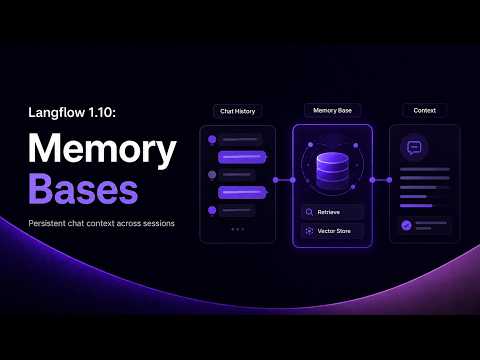
Memory Bases in Langflow 1.10 | Persistent Memory for AI Agents
11:34
Tutorial11:34
Memory Bases in Langflow 1.10 | Persistent Memory for AI Agents
Memory Bases is a new feature in Langflow 1.10 that gives agents persistent memory across conversations. Unlike traditional session-based memory, Memory Bases automatically ingest conversation history into a vector store, allowing agents to retrieve relevant context across sessions and maintain long-term awareness. In this demo, you'll see how Memory Bases can be configured with LLM-powered preprocessing, session filtering, and custom memory ingestion rules to store only the information that matters. This makes it easier to build agents that remember context, personalize interactions, and stay focused on specific domains. This release is part of Langflow 1.10, which also introduces Langflow Assistant, Knowledge Base DB Providers, Internationalization, and several other improvements for building production-ready AI applications. 👉 Learn more about Langflow 1.10 and explore all updates: https://www.langflow.org/blog/langflow-1-10?utm_source=social&utm_medium=video&utm_campaign=langflow_1_10_launch
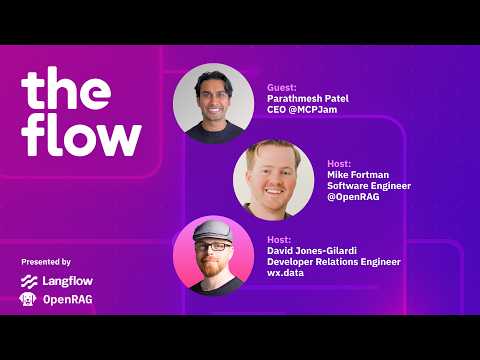
Unbloat Your MCP with Prathmesh Patel from MCPJam
55:57
Tutorial55:57
Unbloat Your MCP with Prathmesh Patel from MCPJam
On this episode of The Flow, we dive into the rapidly evolving world of MCPJam with CEO Prathmesh Patel to explore one of the biggest hidden challenges in modern AI agent systems: token bloat. As MCP servers connect LLMs to tools, APIs, and databases, developers are discovering that not all MCP servers are created equal. Some are engineered efficiently, while others expose massive schemas, bloated responses, and poorly scoped tools that quietly consume huge amounts of context and drive up cost, latency, and agent instability. We unpack how MCPJam helps developers visualize and debug these issues through tool tracing, response inspection, and token analysis, while sharing practical strategies for building leaner, faster, and more reliable AI agent systems. If you're a developer working on or with MCP, this episode is for you. Check it out here: MCPJam - https://www.mcpjam.com OpenRAG - https://www.openr.ag
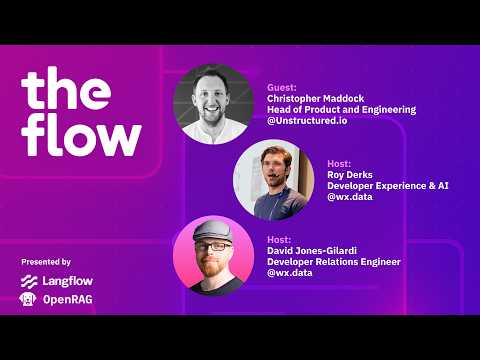
Models Are Smart. Data Is Everything. Building Context-Rich AI Systems with Unstructured.
47:25
Tutorial47:25
Models Are Smart. Data Is Everything. Building Context-Rich AI Systems with Unstructured.
In this episode of "The Flow," hosts David Jones-Gilardi and Roy Derks welcome Chris Maddock from Unstructured. The conversation explores the impact of AI-powered pipelines on data preparation, the evolution of Unstructured's platform, and its integration with AI and enterprise systems. Chris shares insights into his coding journey, the challenges of document processing, and the innovative features that make data transformation more efficient.

Who uses it

Real use cases, no hype
AI Chatbot Prototyping
Rapidly design and test conversational agents with various LLM backends and tool integrations.
RAG Application Development
Visually construct retrieval-augmented generation pipelines connecting documents, vector stores, and language models.
Agentic Workflow Automation
Build and deploy multi-step agents that can reason, plan, and execute tasks using provided tools.
MCP Server Creation
Expose complex AI flows as standardized Model Context Protocol servers for interoperability with other tools.
Data Analysis Pipelines
Create visual workflows for processing, analyzing, and summarizing data from various sources using AI.
API Integration Hub
Connect and orchestrate calls to multiple external services (APIs, databases) as part of a larger AI logic flow.
What's great
  • Visual, drag-and-drop interface for rapid prototyping.
  • Broad integration library for LLMs, vector stores, and tools.
  • Open-source with active community and enterprise cloud option.
  • Native support for Agent frameworks and Model Context Protocol (MCP).
Technical strengths
  • Full Python extensibility under the hood.
  • Deployable as a self-hosted OSS server or via a managed cloud platform.
  • Component-based architecture allows for complex, multi-step agentic workflows.
Where it falls short
  • Learning curve for non-technical users despite the visual editor.
  • Advanced features and scaling may require cloud subscription or robust hosting.
  • Dependency on the Langflow ecosystem for components and updates.
  • Debugging complex, multi-node visual flows can be less intuitive than code.
Technical limitations
  • Abstraction layer may limit fine-grained control for highly specialized logic.
  • Version compatibility can be a concern when upgrading between major releases.
For technical folks

The deep-dive specs

FAQ

Includes technical Q&A
No. The core visual editor allows building flows by connecting components. However, Python knowledge is essential for creating custom components or advanced debugging.

Traffic Insights

Monthly Visits

—

November 2026

Growth Rate

0%

vs last month

Dominance

0%

in Automation

Top Country

—

Top Countries Breakdown

—

Growth Trend

Stable

Traffic has remained stable.

Pricing overview
Freemium Pricing

Langflow Pricing

Langflow uses a freemium pricing structure. Real-time rates, custom enterprise quotas, and plan details are managed directly on their official platform.

Check Pricing on Langflow
Reviews

What the internet actually thinks

Data refreshed weekly. No paid placements.

Trustpilot
Not reviewed yet
G2
G2
Not reviewed yet
C
Capterra
Not reviewed yet
Product Hunt
Not reviewed yet
COMMUNITY COMMENTS

Leave a Comment

Help others make informed decisions. Your honest feedback shapes the community's understanding of this tool.

Tips for commenting

  • •Be specific about features you used
  • •Share real use cases and results
  • •Mention both pros and cons
  • •Keep it honest and constructive
to leave a comment

Your comment is published immediately.

Filter:
Sort:

No comments yet

Be the first to share your experience with this tool.

Alternatives

Not quite the right fit?

Here's what else is out there.