Anyscale

Anyscale

Anyscale is a managed platform built on the Ray open-source compute engine, designed for scaling data-intensive AI workloads. It enables developers and platform engineers to build, run, and optimize distributed training, batch inference, and data curation pipelines across multi-cloud GPU clusters. Key capabilities include orchestrating large-scale multimodal data processing, distributed model training with elastic scaling, batch embedding generation, and post-training workflows like RLHF. It provides fine-grained hardware control, multi-framework support (PyTorch, vLLM, SGLang), and advanced observability. Targeted at AI/ML engineers, platform builders, and foundation model teams, Anyscale removes infrastructure complexity, allowing focus on model development and optimization rather than cluster management.

Automation
Visit website
Added on
Sep 22, 2026
Ray-poweredGPU scalingMulti-cloudPython APIsDistributed trainingData curationBatch inferenceOnline serving
Product information

Everything worth knowing about Anyscale

The complete picture — from everyday features to the technical detail builders and IT folks dig for.

Core features

What it actually does

Scale AI Workloads
Optimize distributed training, data curation, and batch inference pipelines with Ray on Anyscale. Scale existing AI libraries like PyTorch, vLLM, SGLang, and XGBoost with Python APIs across thousands of nodes.
Fine-Grained Machine Control
Compose workloads with distributed functions and classes each running on different CPUs, GPUs, TPUs, or accelerator racks like NVL72.
Multi-Cloud Orchestration
Run the same code across AWS, GCP, Azure, Nebius or CoreWeave to maximize GPU access across regions without cloud-specific rewrites.
Advanced Observability
Monitor and optimize distributed workloads for performance and cost.
Hosted Deployment
Fully managed infrastructure on Anyscale-hosted compute for fast project start.
Bring Your Own Cloud (BYOC)
Deploy inside your own cloud or on-prem with support for VMs or K8s, and use existing GPU reservations.
Technical capabilities
Ray-Based Architecture
Powered by Ray, an open-source distributed computing framework with native libraries for data processing, training, and serving.
Must watch videos
Ray + Kubernetes: The Distributed OS for AI/ML | Ray on the Road – NYC 2025
29:41
Tutorial29:41
Ray + Kubernetes: The Distributed OS for AI/ML | Ray on the Road – NYC 2025
Explore how Ray and Kubernetes form the distributed operating system for AI/ML with insights from Anyscale and Google. Learn about GKE's latest advancements in data access, scheduling, and hardware acceleration, plus how Ray and RayTurbo deliver best-in-class performance for scaling AI workloads from development to production. -- Liked this video? Check out the other presentations: https://www.youtube.com/playlist?list=PLzTswPQNepXlWVHzNpyWxyvyzeOV-5-uA -- 🔗 Connect with us: - Subscribe to our YouTube channel: https://www.youtube.com/@anyscale - Twitter: https://x.com/anyscalecompute - LinkedIn: https://linkedin.com/company/joinanyscale/ - Website: https://www.anyscale.com
What is Anyscale in 8 min
7:30
Tutorial7:30
What is Anyscale in 8 min
Ray is a popular framework for distributed AI, designed to scale Python workloads across CPUs and GPUs for multimodal data processing, distributed training, and online inference. As teams take Ray into production, new challenges appear. Code that worked on a single node now struggles to run on shared, multi-node clusters. Debugging failures takes longer as logs disappear when clusters shut down. And accessing scarce GPUs forces teams to build and manage workflows across clouds. This is why Ray needs a multi-cloud platform. See how Anyscale can be that production-ready platform for AI builders. Get started with Anyscale: https://tinyurl.com/rbfjx2k8 Timestamps: 00:00 – Introduction 00:30 – Why Ray is powerful for distributed AI 01:40 – Why Anyscale makes Ray production-ready 03:10 – Multimodal AI demo 07:03 – Wrap-up and key takeaways
Why Ray Became a Distributed Computing Engine for Modern AI
12:14
Tutorial12:14
Why Ray Became a Distributed Computing Engine for Modern AI
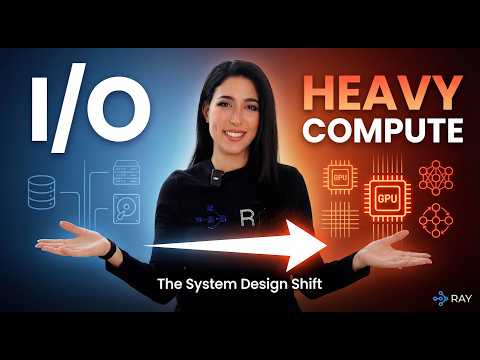
Modern AI workloads changed the fundamental bottleneck in software systems. For years, most applications were limited by I/O - reading from databases, writing to storage, waiting on network latency. But AI systems are different. Training jobs, evaluation pipelines, reinforcement learning loops, and LLM inference all trigger heavy computation across CPUs and GPUs. The bottleneck has shifted from moving data to coordinating compute. Modern AI systems increasingly combine multimodal data (text, images, audio, video) and run across heterogeneous hardware environments that include CPUs, GPUs, and accelerators. These workloads are dynamic, long-running, and failure-sensitive. Coordinating this compute efficiently requires more than traditional cloud orchestration — it requires a distributed execution model designed for compute-heavy systems. In this video, we break down: * The shift from I/O-bound to compute-bound systems * Why traditional Cloud Infrastructure break for AI workloads * Why distributed execution becomes a core infrastructure requirement * How Ray provides a Python-native distributed execution layer * How Ray tasks and actors enable scalable, fault-tolerant compute * How Ray fits into the emerging AI compute infrastructure stack alongside PyTorch, vLLM, and Kubernetes * Why Ray was originally built for reinforcement learning - and why that still matters today Ray is an open-source distributed computing engine built for scaling AI and Python workloads from a laptop to large clusters. It provides the execution primitives - tasks, actors, scheduling, fault tolerance, and resource awareness - required to coordinate dynamic, compute-heavy systems. 🔎 Chapters 00:00 How AI Workloads Changed System Bottlenecks00:45 I/O-Bound vs Compute-Bound Systems 01:37 Why Traditional Cloud Infrastructure Breaks for AI 03:06 How teams are building today for AI workloads 04:26 Why AI Needs a Distributed Execution Layer 05:07 What is Ray? The Distributed Compute Engine explained 06:05 Quick demo of Ray Tasks and Ray Actors 08:29 The Emerging AI Compute Stack Explained 09:54 Ray’s Origins: Why Ray started with Reinforcement Learning 11:16 Ray Joins the PyTorch Foundation under the Linux Foundation 11:30 How to get started with Ray 🔗 Learn More About Ray Ray Documentation: https://docs.ray.ioRay Website: https://www.ray.io Ray GitHub: https://github.com/ray-project/ray Get started with hands-on labs and templates: https://www.anyscale.com/examples

Who uses it

Real use cases, no hype
Distributed LLM Training
Orchestrate and scale fine-tuning of large language models across GPU clusters with elastic resource allocation.
Batch Inference at Scale
Process millions of requests for embeddings, classification, or generation using managed GPU pools.
Multimodal Data Curation
Build large-scale pipelines to process and filter video, image, audio, and text data for model training.
Multi-Cloud AI Platform
Unify AI workloads across AWS, GCP, and Azure with a single control plane and pooled GPU resources.
Post-Training & RLHF
Run reinforcement learning from human feedback (RLHF) and other post-training frameworks natively on Ray.
GPU Cost Optimization
Maximize utilization and reduce costs by dynamically sharing GPU resources across multiple teams and projects.
What's great
  • Seamless scaling of Ray workloads to thousands of nodes.
  • Managed GPU infrastructure eliminates cluster ops overhead.
  • Native support for multi-cloud (AWS, GCP, Azure) without code changes.
Technical strengths
  • Deep integration with Ray ecosystem (Ray Train, Ray Data).
  • Fine-grained hardware allocation for CPUs, GPUs, and specialized accelerators.
  • Elastic scaling and auto-healing for distributed training jobs.
  • Unified observability and monitoring across multi-cloud clusters.
Where it falls short
  • Hosted tier has limited cloud region availability.
  • Cost can escalate rapidly with large-scale GPU usage.
  • Support for hosted tier is business hours only.
  • Full governance features require BYOC or committed contract.
Technical limitations
  • Vendor lock-in risk despite being built on open-source Ray.
  • Advanced debugging tools for complex distributed state are not fully exposed.
For technical folks

The deep-dive specs

FAQ

Includes technical Q&A
Ray is the open-source framework for distributed computing. Anyscale is the fully managed cloud platform that makes it easy to deploy, run, and scale Ray applications on any infrastructure without operational overhead.

Traffic Insights

Monthly Visits

—

October 2026

Growth Rate

0%

vs last month

Dominance

0%

in Automation

Top Country

—

Top Countries Breakdown

—

Growth Trend

Stable

Traffic has remained stable.

Pricing overview
Freemium Pricing

Anyscale Pricing

Anyscale uses a freemium pricing structure. Real-time rates, custom enterprise quotas, and plan details are managed directly on their official platform.

Check Pricing on Anyscale
Reviews

What the internet actually thinks

Data refreshed weekly. No paid placements.

Trustpilot
Not reviewed yet
G2
G2
Not reviewed yet
C
Capterra
Not reviewed yet
Product Hunt
Not reviewed yet
COMMUNITY COMMENTS

Leave a Comment

Help others make informed decisions. Your honest feedback shapes the community's understanding of this tool.

Tips for commenting

  • •Be specific about features you used
  • •Share real use cases and results
  • •Mention both pros and cons
  • •Keep it honest and constructive
to leave a comment

Your comment is published immediately.

Filter by rating:
Sort by:

No comments yet

Be the first to share your experience with this tool.

Alternatives

Not quite the right fit?

Here's what else is out there.