Generable

Generable

Generable is a leading provider of open-source model development, optimization, and training focused on Bayesian statistical modeling for pharmaceutical and biotech research. The platform enables the creation of transparent, explainable models that connect low-level biological measurements (like drug concentration, tumor size) to clinically meaningful outcomes (like patient survival or adverse events). Its core strength lies in using probabilistic programming languages like Stan to perform high-dimensional Bayesian inference, making it suitable for small-data regimes like early clinical trials. The service is built on modern computational statistics methods, including dynamic Hamiltonian Monte Carlo and variational inference, to scale models with hundreds of thousands of parameters. Key use cases include Bayesian clinical trial design, predictive biomarker analysis, dose optimization, and comparing treatment efficacy against standard of care. It is primarily used by biostatisticians,

Search
Visit website
Added on
Sep 22, 2026
Bayesian ModelingStan LanguageClinical TrialsPK/PDSmall DataFDA Guidance
Product information

Everything worth knowing about Generable

The complete picture — from everyday features to the technical detail builders and IT folks dig for.

Core features

What it actually does

Explainable & Transparent Models
Models are defined explicitly through code (e.g., Stan) rather than learned from data, allowing direct tracing of predictions to specific model components.
Well-Calibrated Predictions
Generates full probability distributions over parameters and outcomes instead of single-point estimates, improving accuracy and preserving calibration.
Small Data Regime Optimization
Excels in scenarios with limited data, such as early clinical trials and rare diseases, by leveraging prior knowledge from external sources.
Clinical Trial Design Support
Provides modeling for designing Bayesian trials, analyzing biomarkers, predicting patient progression, and determining optimal dosing strategies.
Focus on PK/PD & Clinical Outcomes
Core research connects low-level measurements (drug concentrations, tumor size) to clinically meaningful outcomes (PFS/OS, adverse events).
Technical capabilities
Scalable Bayesian Inference
Utilizes advanced computational statistics like dynamic Hamiltonian Monte Carlo (HMC) with NUTS and Pathfinder Variational Inference to fit complex hierarchical models.
Stan Probabilistic Programming
Built on the Stan programming language for specifying and fitting Bayesian models, developed by the same core team.
Must watch videos
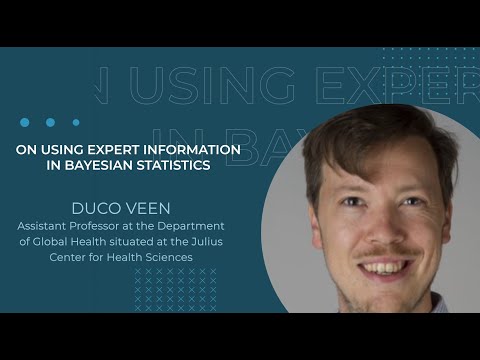
Duco Veen: On using expert information in Bayesian statistics
1:05:06
Tutorial1:05:06
Duco Veen: On using expert information in Bayesian statistics
Duco Veen is an Assistant Professor at the Department of Global Health situated at the Julius Center for Health Sciences and Primary Care of the University Medical Center Utrecht. In that capacity, he is involved in the COVID-RED, AI for Health, and Trials@Home projects. In addition, he is appointed as Extraordinary Professor at the Optentia Research Programme of North-West University, South Africa. Duco works on the development of ShinyStan and has been elected as a member of the Stan Governing Body. In this talk, Duco will discuss how expert knowledge can be captured and formulated as prior information for Bayesian analyses. This process is also called expert elicitation. He will highlight some ways to improve the quality of the expert elicitation and provide case examples of work he did with his colleagues. Additionally, Duco will discuss how the captured expert knowledge can be contrasted with evidence provided by traditional data collection methods or other prior information. This can be done, for instance, for reasons of quality control or training purposes where experts reflect on their provided information.
Juho Timonen: Design of Statistical Modeling Software
56:07
Tutorial56:07
Juho Timonen: Design of Statistical Modeling Software
Abstract Juho presents what he thinks is an ideal modular design for statistical modeling software, based on his experiences as a user, developer, and researcher. He looks at the structure of existing software, focusing on high-level user interfaces that use Stan as their inference engine. Juho uses the longitudinal Gaussian process modeling package lgpr and its future improvements to demonstrate different concepts and challenges related to software design and development. About the speaker Juho Timonen completed his Bachelor’s degree majoring in Mathematics and Systems Analysis at Aalto University, Finland. His first research project was in game theory, and in his Bachelor’s thesis, Juho studied mixed-strategy equilibria in repeated games. He went on to do his Master’s degree at Aalto, majoring in Applied Mathematics. Juho joined the Computational Systems Biology group in the CS department at Aalto, where he got involved in probabilistic modeling and did his Master’s thesis on ODE modeling of gene regulatory networks. Juho continued as a Doctoral student in the same group, where his research is focused on probabilistic modeling.
Jonathan Auerbach: Could voting restrictions be increasing election fraud?
56:42
Tutorial56:42
Jonathan Auerbach: Could voting restrictions be increasing election fraud?
In this talk, Jonathan will present some research he conducted as the 2020-2021 Science Policy Fellow at the American Statistical Association. The talk will review several projects before focusing on the title question, which Science Policy Director Steve Pierson and Jonathan write about in a recent publication for Statistics and Public Policy. The abstract is summarized below. Jonathan will conclude by challenging viewers to enter an exciting new prediction competition that will be run by the George Mason University Statistics Department in February. In the paper, we estimate the change in the reported number of voter fraud cases when states switch to conducting elections by mail. We consider states where many voters have historically received ballots by mail and a subset where registered voters are automatically sent ballots by mail. We compare the number of voter fraud cases in these states to the number of cases in remaining states using difference in differences and matrix completion (via nuclear-norm penalization). We find no evidence that voting by mail increases the risk of voter fraud overall. In fact, we estimate Washington would have reported 73 more cases of fraud between 2011 and 2019 had it not introduced its vote-by-mail law. About the speaker ----------------------------- Jonathan Auerbach is an Assistant Professor in the Department of Statistics at George Mason University. His research covers a wide range of topics at the intersection of statistics and public policy. Previously, Auerbach served as a science policy fellow at the American Statistical Association. He was also a researcher at the Center for Urban Research at the City University of New York and an analyst for New York City’s legislature, the City Council.

Who uses it

Real use cases, no hype
Bayesian Clinical Trial Design
Design and optimize adaptive trial protocols, including dose selection and interim analyses.
Pharmacokinetic/Pharmacodynamic (PKPD) Modeling
Model drug concentrations and their relationship to therapeutic and toxic effects.
Biomarker Prediction & Validation
Develop predictive models to assess biomarker efficacy and identify patient responders.
Survival & Progression Analysis
Model patient progression-free survival (PFS) and overall survival (OS) with uncertainty.
Dose-Response & Exposure-Response Analysis
Determine optimal dosing for individual patients or specific treatment arms.
Small Data & Rare Disease Research
Apply prior knowledge to make inference from limited patient data in early-stage or rare disease studies.
Competitive & Standard-of-Care Comparison
Quantify the probability that a new treatment is superior to existing options.
What's great
  • Excels with small datasets (e.g., early clinical trials, rare diseases).
  • Built by the core developers of the Stan probabilistic programming language.
  • Provides well-calibrated predictions with full uncertainty quantification.
  • Directly addresses FDA guidance for Bayesian methods in clinical trials.
Technical strengths
  • Models are fully transparent and explainable via code, not black-box data.
  • Leverages cutting-edge Bayesian algorithms (HMC/NUTS, Pathfinder VI).
  • Specialized in connecting low-level measurements to clinical outcomes (PK to PFS/OS).
Where it falls short
  • Highly specialized for pharma/biotech clinical trials; not a general-purpose tool.
  • Complex Bayesian modeling has a steep learning curve for non-statisticians.
  • Pricing is opaque; requires contacting sales, no self-serve option.
  • Few publicly available model examples or tutorials compared to mainstream ML tools.
Technical limitations
  • Relies on the Stan ecosystem; performance can hinge on model convergence and diagnostics.
  • Scalability to extremely large datasets (beyond traditional clinical trial sizes) is unproven.
For technical folks

The deep-dive specs

FAQ

Includes technical Q&A
We provide open-source model development, optimization, and training services built on Bayesian inference and probabilistic programming, primarily using the Stan language.

Traffic Insights

Monthly Visits

—

October 2026

Growth Rate

0%

vs last month

Dominance

0%

in Search

Top Country

—

Top Countries Breakdown

—

Growth Trend

Stable

Traffic has remained stable.

Pricing overview
Paid Pricing

Generable Pricing

Generable uses a paid pricing structure. Real-time rates, custom enterprise quotas, and plan details are managed directly on their official platform.

Check Pricing on Generable
Reviews

What the internet actually thinks

Data refreshed weekly. No paid placements.

Trustpilot
Not reviewed yet
G2
G2
Not reviewed yet
C
Capterra
Not reviewed yet
Product Hunt
Not reviewed yet
COMMUNITY COMMENTS

Leave a Comment

Help others make informed decisions. Your honest feedback shapes the community's understanding of this tool.

Tips for commenting

  • •Be specific about features you used
  • •Share real use cases and results
  • •Mention both pros and cons
  • •Keep it honest and constructive
to leave a comment

Your comment is published immediately.

Filter by rating:
Sort by:

No comments yet

Be the first to share your experience with this tool.

Alternatives

Not quite the right fit?

Here's what else is out there.